Kartik Balpande, growth marketing and AI automation

I bring businesses customers. Then I automate the work they create.

Eight years running ads, SEO, social and content. Now I also build the systems that answer the leads, take the orders, send the bills and report the results, so your team doesn’t have to.

How the work runsRunning
  • Trigger
  • Automated
  • AI step
  • Check
  • Person
  • Saved
First, bring the customers in
TriggerSomeone clicks your adGoogle, Meta or LinkedIn
AutomatedA WhatsApp reply in secondsDay or night
AI stepThe right questions askedNeed, budget, timing
PersonSales calls a qualified leadWith the full chat in hand400+ a month
SavedLead quality sent back to the adsSo bidding chases buyers
Then, automate the work they create
TriggerA customer orders on WhatsAppIn their own shorthand
AI stepEvery line read and matchedHindi, English or mixed13 of 13 lines
AutomatedBuying list and bill madeBefore the market opens
CheckLate payers flaggedBefore the next delivery
SavedThe day’s profit on one screenCash, bank, costs, sales2–3 hrs saved
Run 1Starting…

Two real systems, simplified: the Eorb Solutions lead assistant on top, the V4Veg ordering system below.

₹1 Cr+Google Ads spend managed on one US account (US$123K)
81%lower cost per lead than the category, at Taskmo
400+qualified leads a month from one WhatsApp system
152buyer enquiries in one month, for a manufacturer
Nubius NetworkGolden ThreadzsEorb SolutionsTaskmoV4VegHype It OnStyle StoryPixxel CityMagnum OreSpanworks
Hiring? Growth marketing and AI automation, 8 years. Open to full-time or contract, remote, available now.
Services

What I can do for your business.

Find the problem that sounds like yours. Each one links to work I’ve done, so you can check the result before we talk.

Bring in customers
01

Google & Meta Ads

Sounds like you?You’re spending on ads, but can’t tell which rupee brings in customers.

  • New campaigns, or a rescue of the ones you have
  • Tracking on every call, form and WhatsApp enquiry
  • A weekly report: what you spent, what came back
ProofTaskmo, 81% lower cost per lead
02

SEO & Google Business Profile

Sounds like you?People search for what you sell, and find your competitors.

  • Your Google profile, set up and kept active
  • Listings like IndiaMART and JustDial
  • Pages written the way your buyers search
ProofMagnum Ore, 152 enquiries in one month
03

Websites & online stores

Sounds like you?You get visitors, but they don’t enquire or buy.

  • Fast websites and landing pages built to get enquiries
  • Shopify stores, including for overseas buyers
  • Checkout, payments and tracking set up properly
ProofGolden Threadzs, 3.2× revenue in 90 days
Save your team’s time
05

AI receptionist & lead follow-up

Sounds like you?Enquiries arrive faster than your team can reply, and slow replies go cold.

  • Every enquiry on WhatsApp, website chat or Facebook answered in seconds, day or night
  • The right questions asked, the best leads picked out
  • Qualified leads booked into your calendar, with the full chat for sales
ProofEorb Solutions, 400+ qualified leads a month
06

Business workflow automation

Sounds like you?Your team retypes orders, bills and reports by hand, every day.

  • Orders read straight from WhatsApp messages
  • Bills, payment reminders and credit checks
  • A daily view of sales, costs and profit
ProofV4Veg, 2–3 hours saved every morning

Most clients start with one of these and add the next once the first is paying for itself. Not sure which comes first? Ask for a free audit

Design & content

The creative that runs in the campaigns.

Ads, price cards, menus, brochures and social posts. All of it made for a campaign I was running, none of it for show.

V4VegStyle Story SalonsSpanworksV4VegStyle Story SalonsHype It On
Kartik Balpande
About

Hi, I’m Kartik. I make marketing pay for itself.

For 8 years I’ve worked both halves of growth: the ads, search and content that bring customers in, and the systems that answer them, take their orders and send the bills.

Five of those years went into growing Taskmo, a two-sided gig marketplace, from launch. Since 2023 I’ve worked freelance under the Hype It On name, for clients in India and Australia. Most of what I build now is automation: an ordering system 20 restaurants use every day, a prospect engine that audits websites overnight, and a growth engine designed for an Australian marketplace. I work from Bengaluru, with hours that overlap Australia, the UK and the US.

Experience

8 years in growth, ads and automation.

2023 – now · Remote

Growth Marketing & AI Automation Consultant, Freelance

  • Client work delivered under the Hype It On name. Manage up to ₹15L+ a month (≈ US$17K) across Google, Meta and LinkedIn Ads, including US$123K (over ₹1 crore) on one US Google Ads account.
  • Built the website audit agent and lead-sourcing agent behind its sales, now sourcing leads for a sales rep in Australia.
  • Designed a two-sided growth engine for Nubius Network (Australia): eight workflows covering guard onboarding on WhatsApp, lead sourcing, scoring and outreach.
  • Other work includes Eorb Solutions (400+ qualified leads a month), Golden Threadzs (3.2× revenue in 90 days) and V4Veg (an order-to-profit system 20 restaurants order through).

If I join full-time: every client account is handed over with a proper transition. Clients keep their service and the role gets all of my attention.

Contract

Lead Marketing Manager: international wellness brand

  • Led ₹8.4L a month in Meta and Google awareness campaigns, via a partner agency.
2018 – 2023 · Nagpur

Digital Marketing & Social Media Manager, Taskmo

  • Owned digital marketing for a two-sided gig-work marketplace, from launch to scale: all social media and PPC.
  • Grew both sides: sourced client projects for the gig workforce, and ran gig-worker acquisition and onboarding.
  • Cost per lead 81% below the category benchmark with local Meta Ads.
  • LinkedIn following up 180% in 12 months, organically; weekly ROI dashboards for leadership.
2017

B.Sc., Shivaji Science College, Nagpur

Working together

Four ways to start.

Fix one thing

A fixed-price project: a website rebuilt, an ad account rescued, one task automated. Price agreed in writing before work starts.

Start a project

Monthly growth

Ads, SEO and content every month, with a report that shows what it returned. Every account login stays yours.

Talk about a retainer

Automate a workflow

Pick the task your team repeats every day. I build the system, test it on your real data and train your team.

Talk about a system

Hire me

Need someone to own growth, marketing automation, or both? I’m open to full-time and contract roles, remote, across AU, UK and US hours, and can start now. Client accounts get a proper handover, so the role gets my full time.

Download résumé
  • Fixed price, in writingScope, price and dates agreed before work starts.
  • Everything in your nameAd accounts, domain, hosting and files are yours from day one.
  • No lock-inMonthly work runs month to month, with 30 days’ notice.
  • Quote in 48 hoursTell me the problem; get a plan and a price within two working days.
Free marketing auditYour website, ads and Google presence, with the loss estimated in money. Back in 48 hours.
Request it
Free workflow reviewShow me one task you do by hand every day. I’ll show what it costs and how it could run itself.
Request it
← Home
Automations

Systems that do the work nobody has time for.

Each one replaces a task someone did by hand, every day. For each you can see what it was costing, how the system works and what it produces.

Built for client work

Ten running, one in design.

Nubius NetworkSystem design

A growth engine for both sides of a marketplace

Guards onboarded on WhatsApp, businesses found from public buying signals, and a supply check before any pitch.

8 workflows, one database, owned by the client
How it works
V4VegLive system

WhatsApp orders, entered without retyping

Restaurant orders in shorthand Hinglish become a clean order sheet in seconds.

13 of 13 lines matched on a real restaurant order
How it works
V4VegLive system

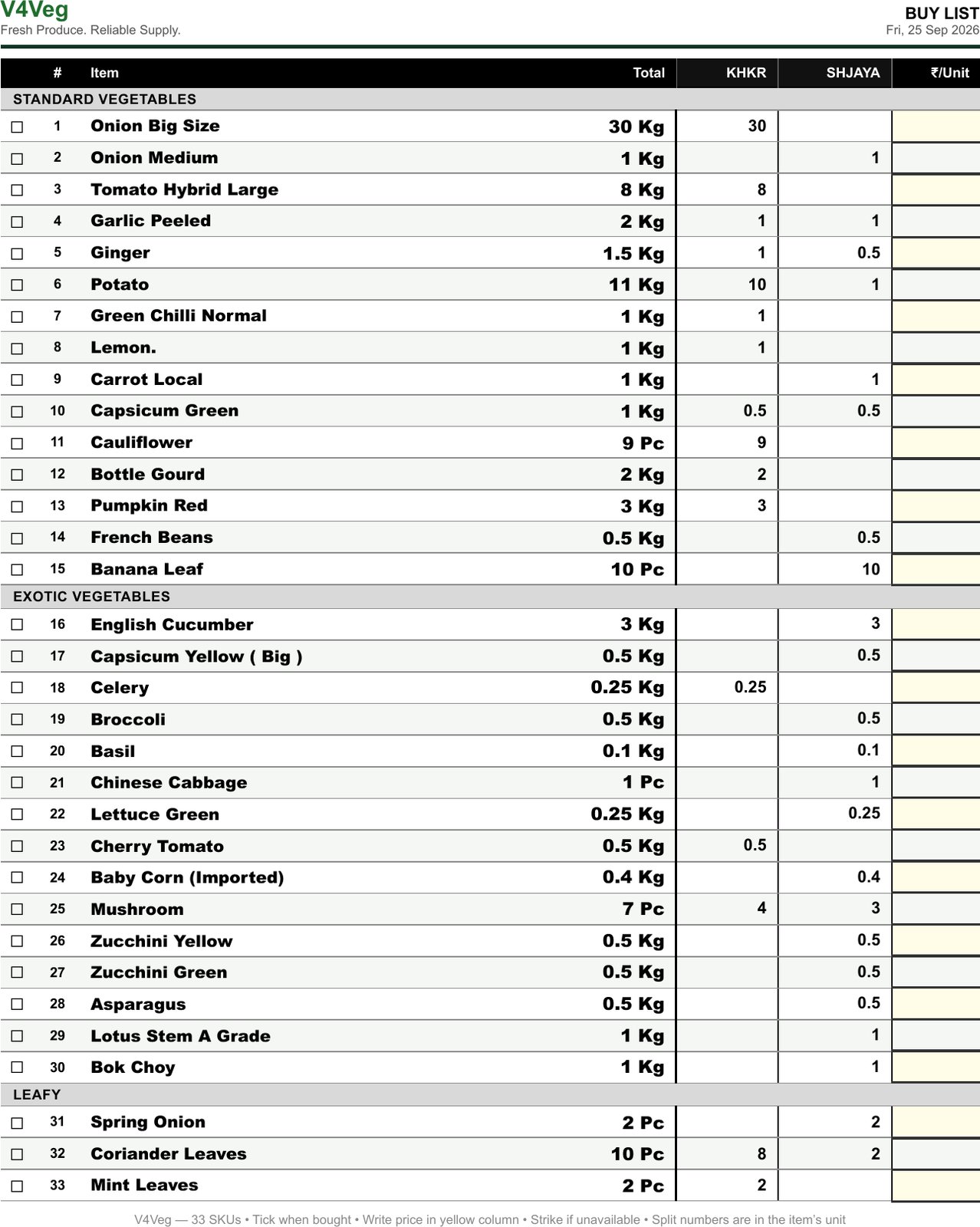
The buying list, on the buyer’s phone the night before

Every kitchen’s order added up, split and sorted by market section, ready before the buyer leaves for the market.

One page, every kitchen, before the market opens
How it works
V4VegLive system

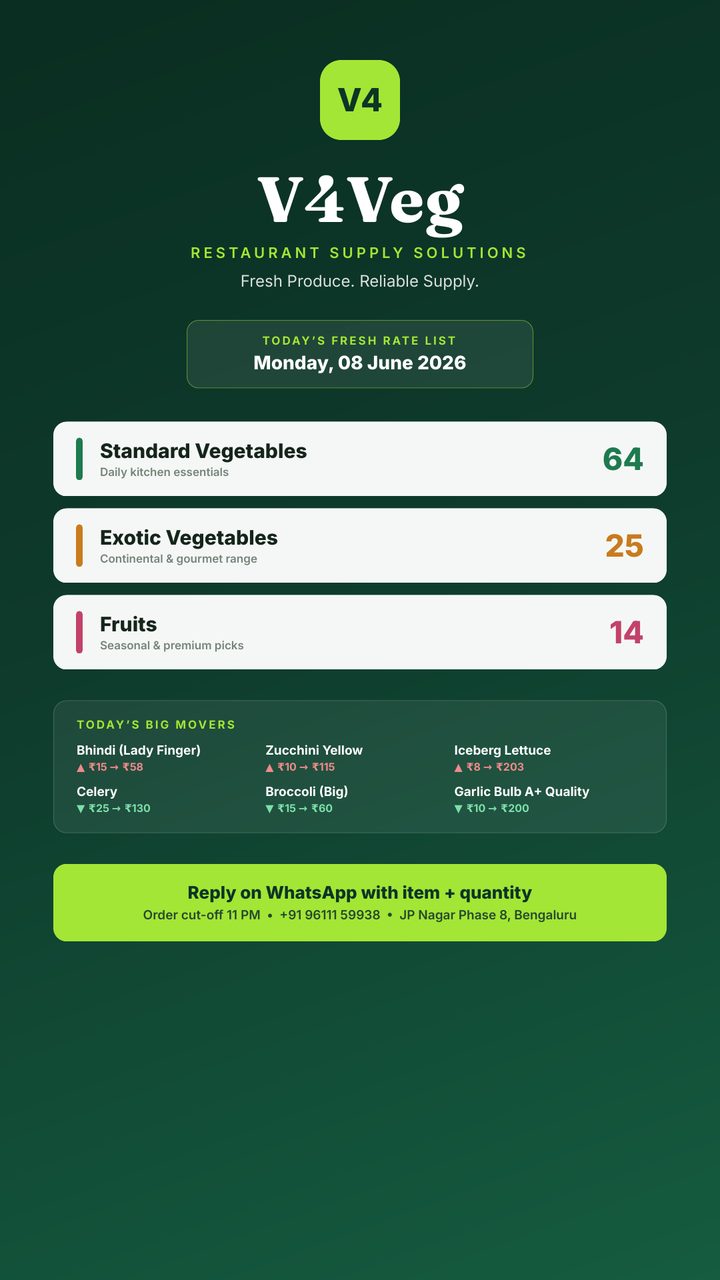
Daily price cards, built and sent every evening

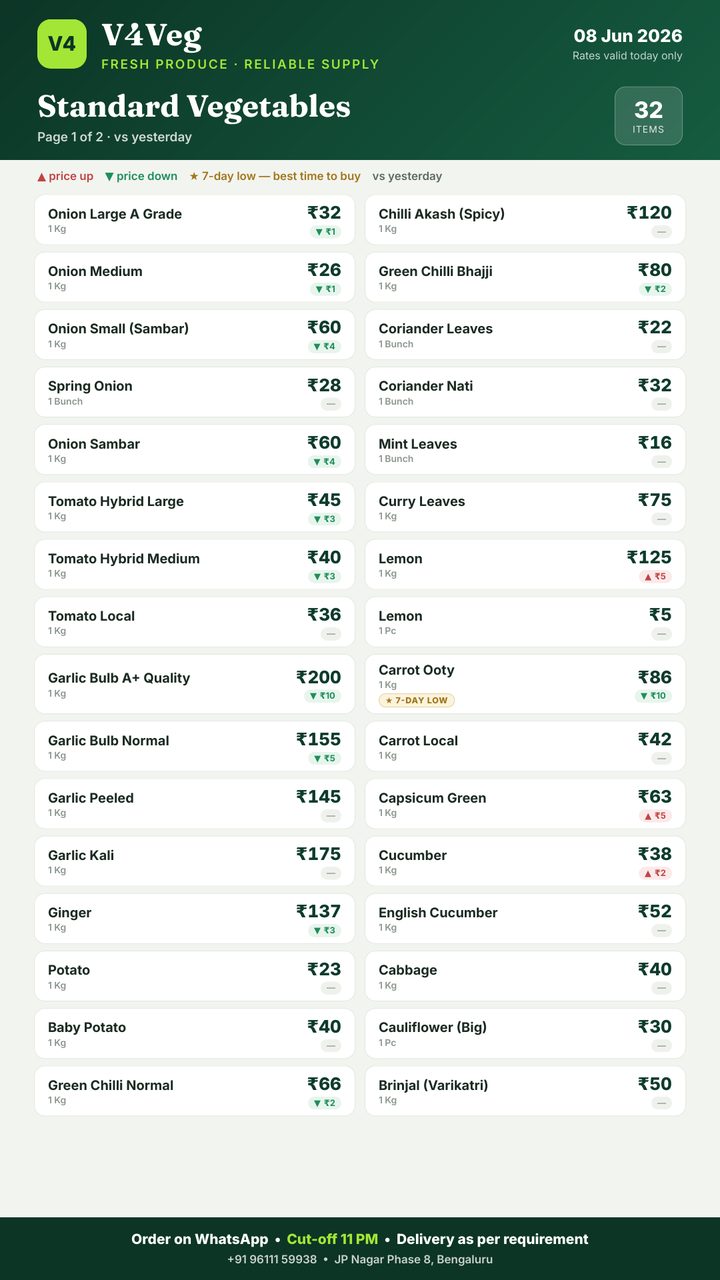
Prices move every day. Fresh, branded rate cards go out each evening with every change marked.

100+ items priced every evening
How it works
V4VegLive system

Billing and credit control

Bills made automatically, payments matched to the oldest bill first, and late payers flagged before the next delivery.

Every rupee owed, visible every day
How it works
V4VegLive system

Daily close and live profit dashboard

Cash, bank, costs and sales reconciled every day, with profit after fixed costs and break-even always current.

Caught running costs that never reached the books
How it works
Eorb SolutionsClient system

Every paid lead answered and qualified in seconds

A WhatsApp assistant greets every ad lead, asks the right questions and hands sales only the ones worth calling.

400+ qualified leads a month
How it works
Hype It OnLive system

A website audit that shows the loss in rupees

Turns “your website needs work” into a number an owner believes: enquiries and money lost each month.

The first meeting starts with the fix, not the pitch
How it works
Hype It OnLive system

Prospects found, checked and ranked overnight

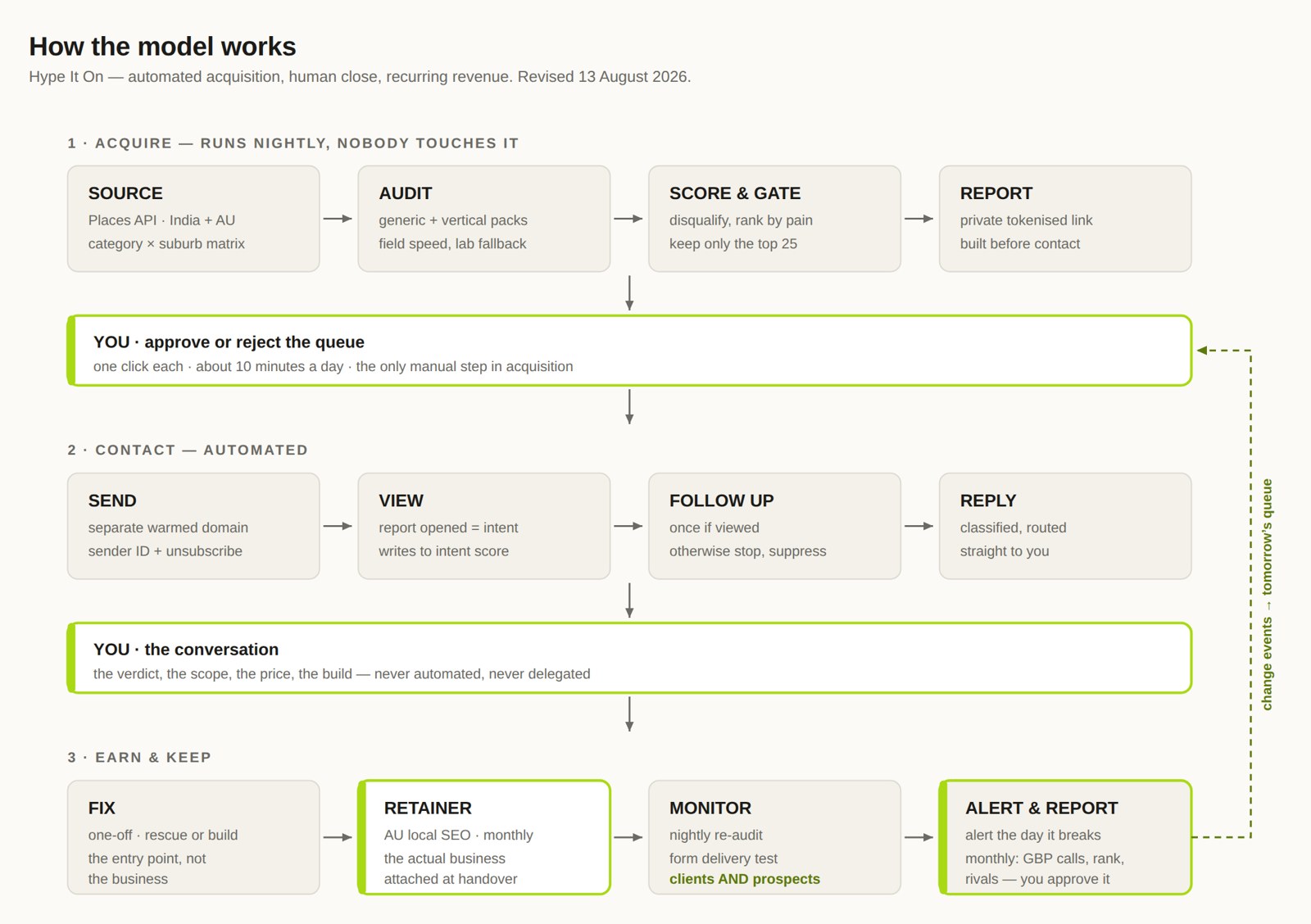
Every night it finds local businesses, audits their websites and ranks the 25 that most need help. A person approves every contact.

About 10 minutes a day of human time
How it works
TaskmoClient system

Weekly growth reporting and test loop

Two audiences, many cities, weekly ad tests, one dashboard showed leadership where every rupee worked.

81% lower cost per lead than the category
How it works
Style Story SalonsClient system

First visit to regular client

Local ads bring the first visit; reminders and a stepped offer bring them back for the second and third.

Weekday chairs, filled
How it works

Ready to deploy

Proven patterns, shown on sample data, set up around your business.

← All work
Golden Threadzs · Shopify store · Meta Ads · SEO · India · Australia · New Zealand

One store, two continents.

A Kashmiri ethnic-wear label with beautiful products, no online store, and buyers split between India and the Indian community in Australia and New Zealand.

3.2×revenue in 90 days
136+products across 10+ collections
4currencies: INR, AUD, USD, NZD

What was wrong

Overseas buyers need their own currency, familiar payment options and confidence that the parcel will arrive. Without that, they browse and leave.

What I did

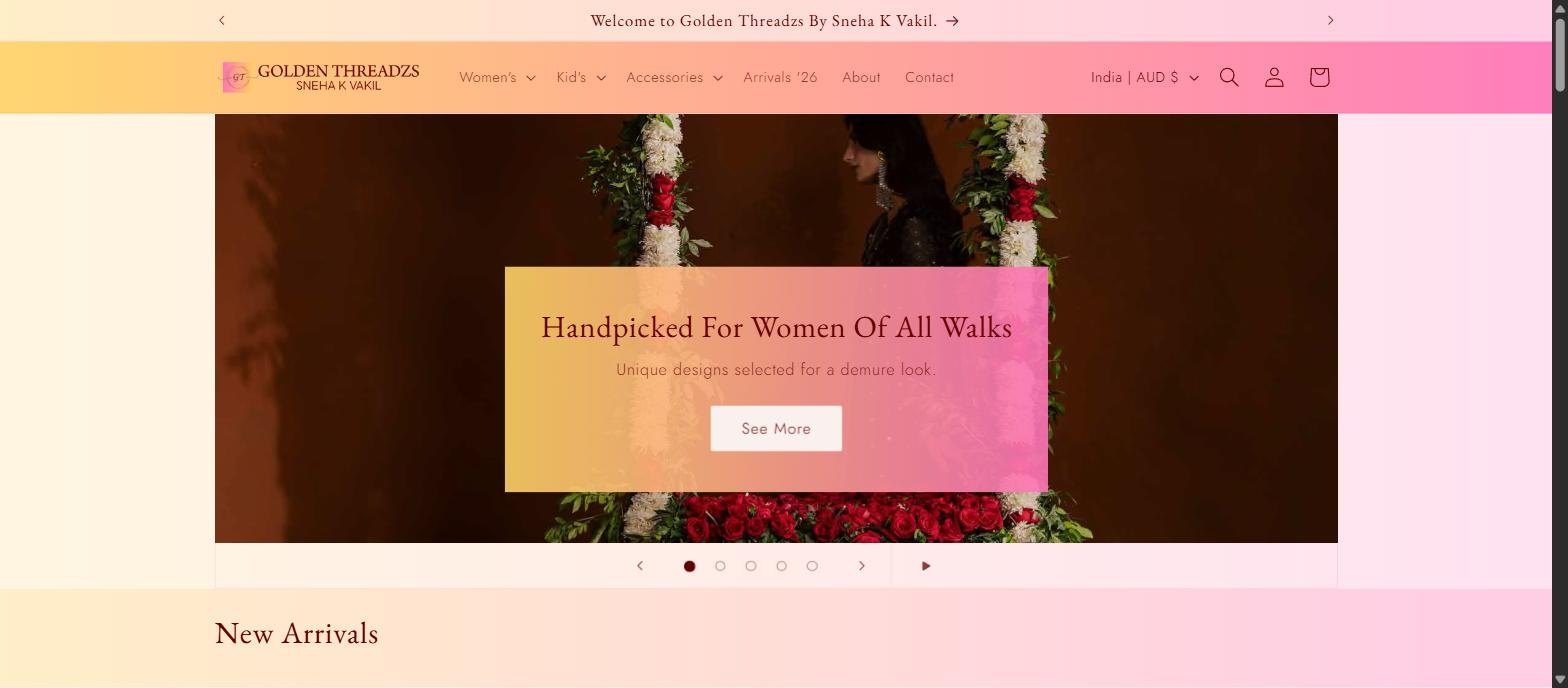
Built a Shopify store with 10+ collections that shows prices in the visitor’s currency, and ran Meta Ads aimed at the diaspora, including product ads priced in their currency.

What changed

Revenue grew 3.2× in 90 days, with a checkout set up for international buyers: local address formats, clear shipping and seven ways to pay.

Homepage: the currency changes automatically by region.
Homepage: the currency changes automatically by region.goldenthreadzs.com ↗
New arrivals, arranged by collection.
← All work
AI development agency · Google Ads · White label · US enterprise market

A Google Ads account, re-aimed at real buyers.

An AI development agency selling projects of US$10,000 and up to US companies. I took over its Google Ads account under the agency partner’s brand.

258conversions recorded
₹5.72Lad spend managed, Jun 2025 to Sep 2026
₹2,216average cost per conversion
7,120clicks

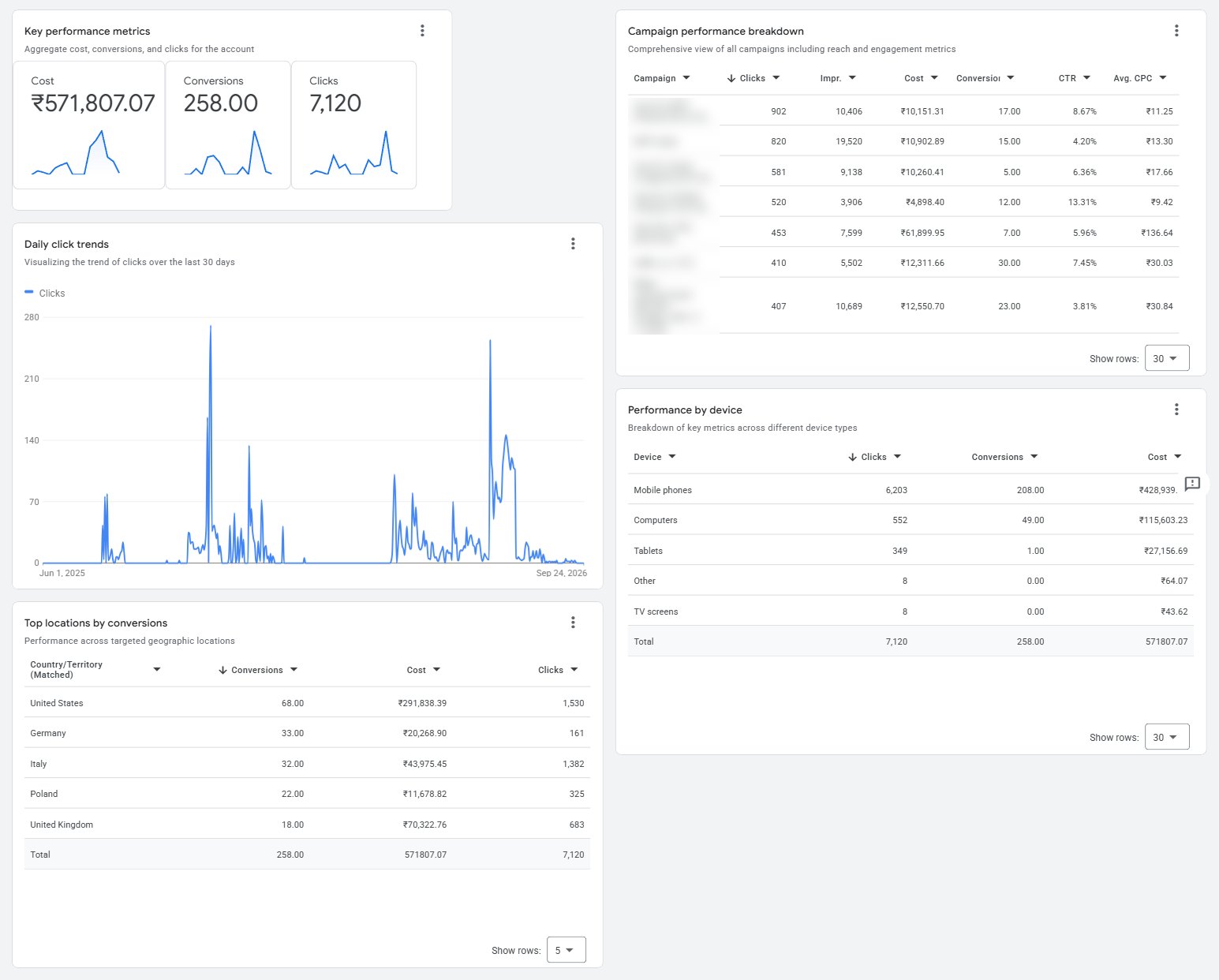
The results, from the account dashboard

Every number below is read straight off the screenshot. Campaign names are blurred for the client’s privacy.

Google Ads account dashboard: ₹571,807 cost, 258 conversions, 7,120 clicks, with tables by campaign, device and country. Campaign names are blurred.
  1. 1
    258 conversions from ₹5.72 lakh₹571,807 spent for 7,120 clicks and 258 conversions, which works out to about ₹2,216 per conversion.
  2. 2
    Best campaign: ₹410 a conversionOne campaign brought 30 conversions for ₹12,312. Click-through rates across campaigns ran from 3.8% to 13.3%.
  3. 3
    The United States led68 conversions from the US, followed by Germany (33), Italy (32), Poland (22) and the United Kingdom (18).
  4. 4
    Buyers came from their phones208 of the 258 conversions were on mobile, with 49 more on desktop.

What I inherited

Google’s built-in lead form had collected 81 submissions over its life, and not one became a real lead. Bidding was learning from junk, and fringe ad groups were spending on people who would never buy.

What I did

Removed the lead form, paused five low-intent ad groups, blocked DIY, course and tool searches with negatives, and capped bids at ₹2,000 a click so a weak Quality Score could not burn the budget. I rebuilt tracking so Google optimises for a qualified lead, not a form fill.

What changed

258 conversions across the account at about ₹2,216 each, led by the United States. Spend goes to searches from companies buying development work, and every click can be traced to whether it became a conversation.

← All work
US therapy practice · Google Ads · Search and Performance Max · US market

A therapy practice’s Google Ads, scaled 7× at the same cost.

A US therapy practice that books new clients from phone calls and enquiry forms. I run its Google Ads: Search first, with Performance Max added on top.

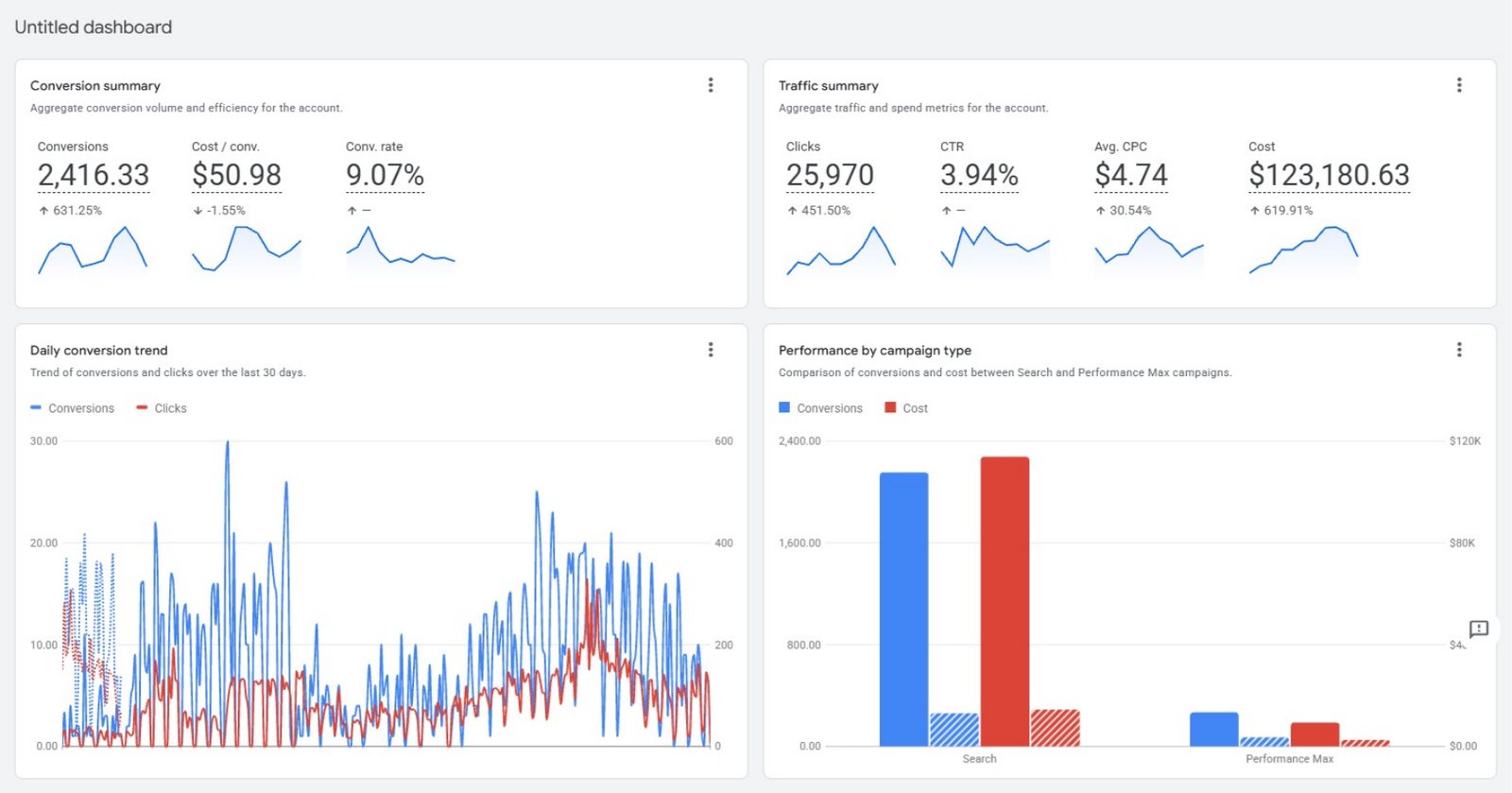
2,416conversions recorded
$123Kad spend managed
$50.98average cost per conversion
9.07%of clicks became a conversion

The results, from the account dashboard

Every number below is read straight off the account dashboard. The practice is not named, for the client’s privacy.

Google Ads dashboard for a US therapy practice: 2,416 conversions, $50.98 cost per conversion, 9.07% conversion rate, 25,970 clicks, $123,180.63 cost, with a daily trend and a Search versus Performance Max comparison.
  1. 1
    2,416 conversions, up 631%From 25,970 clicks, a 9.07% conversion rate. The dashboard compares this with the same length of time before, and conversions are up 631%.
  2. 2
    Cost per conversion held flat$50.98 a conversion, 1.55% lower than the period before, while volume grew more than seven times.
  3. 3
    $123K spent, $4.74 a click$123,180.63 for 25,970 clicks at a 3.94% click-through rate. Spend rose 620% on the period before.
  4. 4
    Search does the heavy liftingSearch brought about 2,100 conversions for roughly $113K. Performance Max added about 250 for around $9K.

What counts as a conversion

Only two things: an enquiry form sent, or a phone call that lasted more than 120 seconds. Misdials, hang-ups and spam calls never reach the count, so bidding learns from people who actually spoke to the practice.

What I did

Built the account around Search, where people are actively looking for a therapist, and added Performance Max on top once Search was converting. Budget was raised in steps, and cost per conversion was watched at each step so it never drifted up.

What changed

Spend grew about seven times and conversions grew with it, at the same cost per conversion. Roughly 9 in every 100 clicks now becomes an enquiry form or a real call.

← All work
Eorb Solutions · Paid ads · WhatsApp lead assistant · B2B SaaS

Every paid lead, answered in seconds.

A B2B software company whose ads brought in more WhatsApp enquiries than the sales team could answer.

400+qualified leads a month
₹6.6Lmonthly ad budget managed
2 weeksfrom brief to live

What was wrong

Leads that waited an hour went cold. Sales spent their day on people who were never going to buy.

What I did

Ran Google, Meta and LinkedIn campaigns on a ₹6.6L monthly budget, and built a WhatsApp assistant that answers every lead in seconds and asks the qualifying questions.

What changed

400+ qualified leads a month reach sales with the full conversation. Unclear cases go to a person, not a guess.

The systems behind it

← All work
Taskmo · Performance marketing · Social · Reporting · India · 2018 – 2023

Five years growing a two-sided marketplace.

A gig-work marketplace that had to win two audiences at once, workers and the businesses that hire them, in city after city.

81%lower cost per lead than the category benchmark
+180%LinkedIn followers in 12 months, organic
5 yearsowning digital marketing, launch to scale

What was wrong

Two very different audiences, many cities and a tight budget. So every rupee of cost per lead mattered.

What I did

Local Meta Ads aimed separately at workers and employers, new ad tests every week, and a weekly dashboard so leadership saw return on spend.

What changed

Cost per lead ended up 81% below the category benchmark, and LinkedIn followers grew 180% in a year without paid promotion.

The systems behind it

← All work
V4Veg · Brand, website and operating system · Bengaluru

A fresh-produce supplier, run from WhatsApp.

Restaurants order late at night, on WhatsApp, in shorthand. V4Veg needed to look as reliable as its service, and to handle every order without anyone retyping it.

20restaurants ordering through the system
3,828order lines delivered and recorded
13/13lines matched on a real test order
2–3 hrssaved every morning

Watch one order go through

Five connected systems carry a WhatsApp message to the buying list, the bill and the day’s profit. A person steps in only where judgment is needed.

One order, from message to profitRunning daily
  • Trigger
  • Automated
  • AI step
  • Check
  • Person
  • Saved
TriggerA kitchen sends its orderOn WhatsApp, late at night
AI stepEvery line is readItem, quantity and unit13 of 13 on a test order
CheckSure of every line?Matched to that kitchen’s words
PersonA person checks one lineOnly the line it wasn’t sure of
AutomatedOrder savedA resent order replaces the old one
AutomatedBuying list builtSorted by market sectionOne page, every kitchen
AutomatedBill madeFrom the same order
CheckPayment overdue?Matched to the oldest bill first
PersonFlagged before deliveryThe owner decides
SavedThe day closes itselfCash, bank, costs, profitLive profit
Run 1Starting…

Simplified from the live system. Each step links to a full write-up below.


What was wrong

Orders were retyped by hand every morning, short supply was shared out by guesswork, and billing ate the hours before delivery. One misread line meant the wrong vegetables on the truck.

What I did

The brand, the website and daily price cards, then five connected systems on tools the team already used. Restaurants changed nothing: they still just send a WhatsApp message.

What changed

The system is used every day. Orders take seconds to enter, payments are tracked daily, and there is a live view of whether the business is making money.

What the kitchen sends, and what lands in the sheet

What the kitchen sends.

Sample data
Order — Restaurant ARead and matched automatically
Sent asMatched itemQty
tamatar 8kgTomato Hybrid Large8 Kg
onion big 30 kgOnion Big Size30 Kg
adrak 1kgGinger1 Kg
dhaniya 8Coriander Leaves8 Pc
mushroom 4 pktMushroom4 Pc
limbu 1 kgLemon1 Kg
gobi 9Cauliflower9 Pc
baby corn 400gBaby Corn — check: imported or local?0.4 Kg

What lands in the order sheet. The one unsure line is flagged for a person.

Built on
  • Google Sheets
  • Apps Script
  • Gemini API
  • WhatsApp

The brand and website

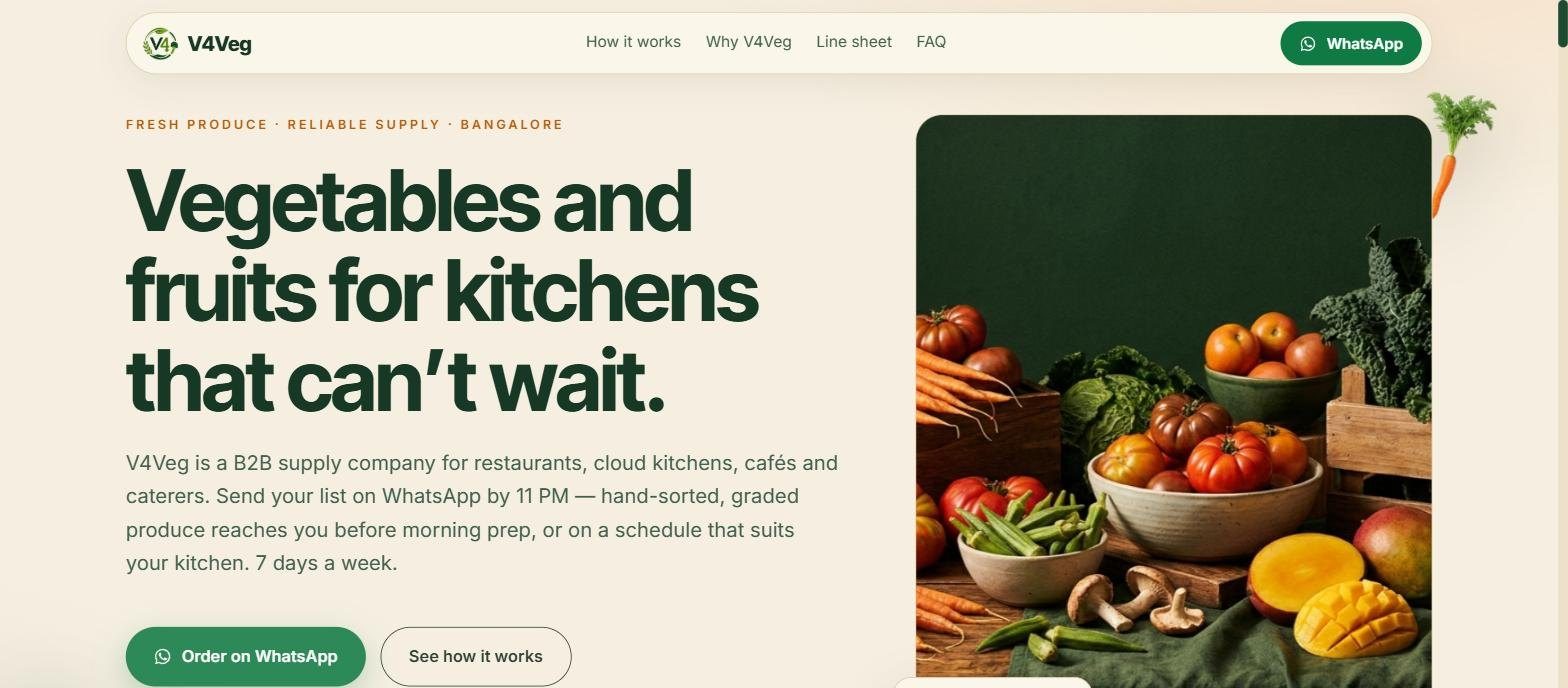
Homepage: order on WhatsApp by 11 PM, delivered before morning prep.
Homepage: order on WhatsApp by 11 PM, delivered before morning prep.v4veg.com ↗
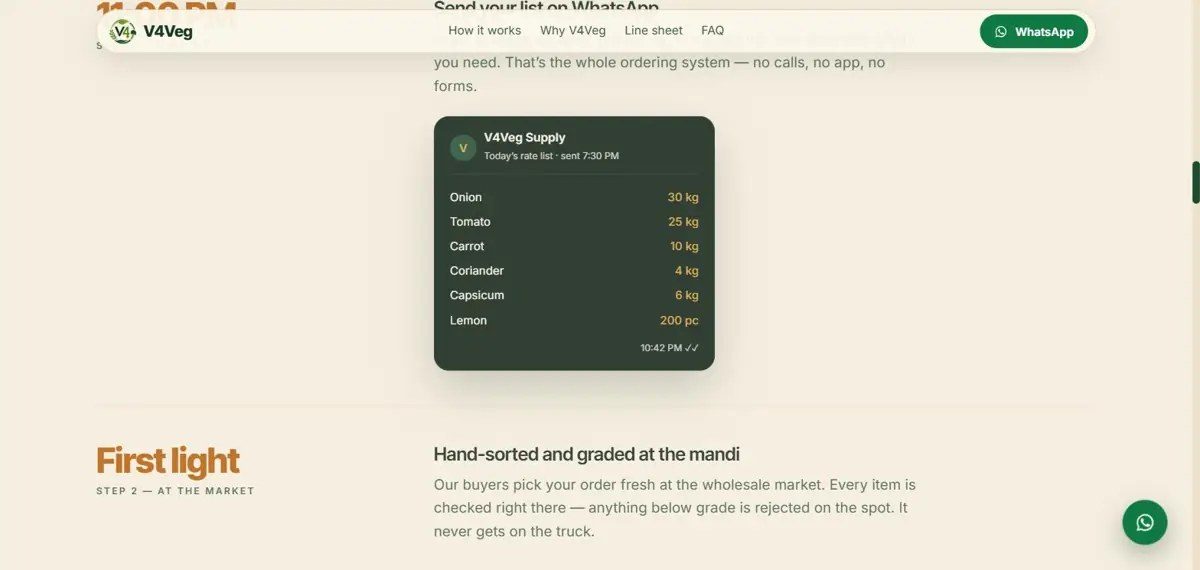
How ordering works, as the website explains it.

Brand and content

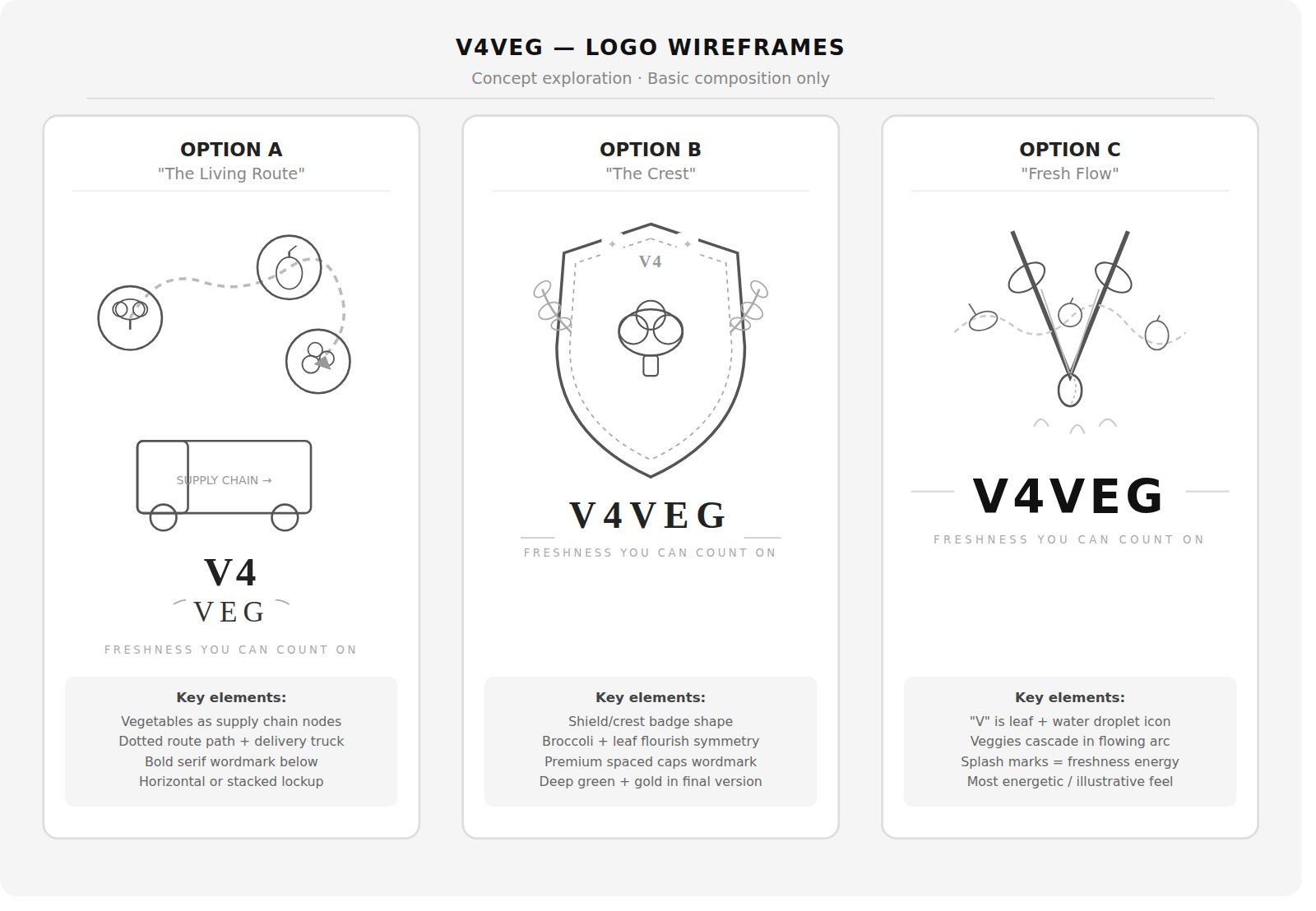
Logo: three first ideas
Logo: final
Logo: final
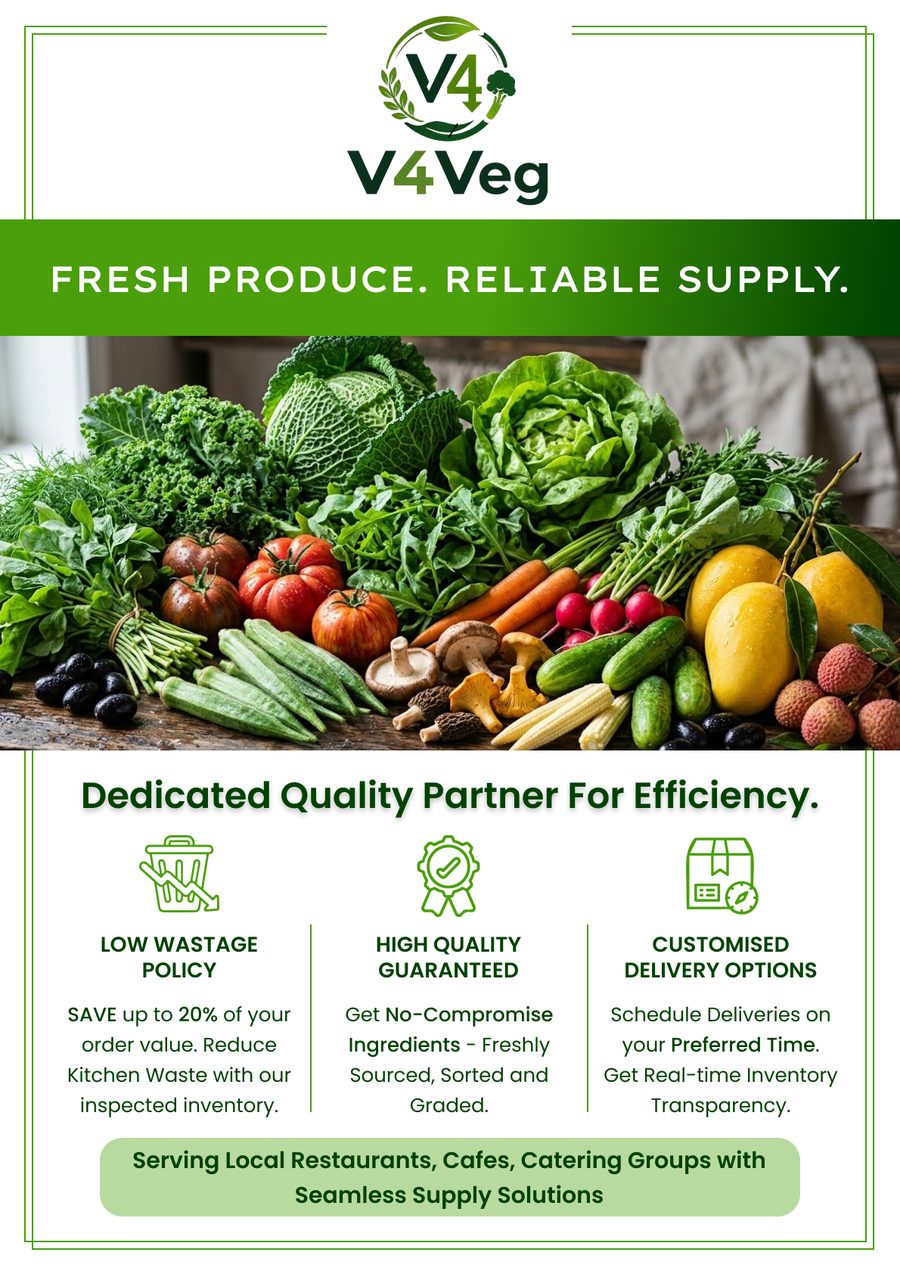
Flyer for kitchen visits
Daily price card
Daily price card
Ad for restaurant owners
Ad for the exotic range

Launch film: four openings to test

Opening A: the product
Opening B: the price
Opening C: the count
Opening D: the problem (plays)

The five systems, one by one

← All work
Hype It On · My freelance practice · India and Australia

A sales engine that finds, audits and ranks its own prospects.

Hype It On is the name I deliver freelance client work under. Before it asks an owner for a meeting, it has to prove their website is costing them money, as a number.

25prospects ranked every night
10 minof human time a day
48 hrsfrom audit request to report

How a stranger becomes a costed lead

The engine does the finding and the arithmetic overnight. A person decides who gets contacted.

The prospect engineRuns every night
  • Trigger
  • Automated
  • AI step
  • Check
  • Person
  • Saved
  • Stop
TriggerEvery night, by postcodeStarting in Victoria
AutomatedFinds local businessesFrom Google Maps listings
AutomatedAudits each websiteLike a customer on a phone
AI stepPrices each defectAs money lost each monthA number, not an opinion
CheckOn the Do Not Call register?Checked before any contact
StopDroppedNever contacted
AutomatedRanks the top 25Who needs help most25 a night
PersonThe rep approves each contactAbout 10 minutes a day10 min a day
SavedSaved to the call screenOne screen per prospect
Run 1Starting…

What was wrong

Owners had heard “your site needs work” from every agency that called. Nobody had shown them what it was costing, so nobody was believed.

What I built

A website built around a sample audit, an audit system that estimates the monthly loss, a prospect finder that ranks who needs help most, and ads written for each industry.

What changed

Meetings start with the fix, not the pitch. The same engine now sources leads for a sales rep in Victoria, Australia, with Do Not Call rules enforced before any contact.

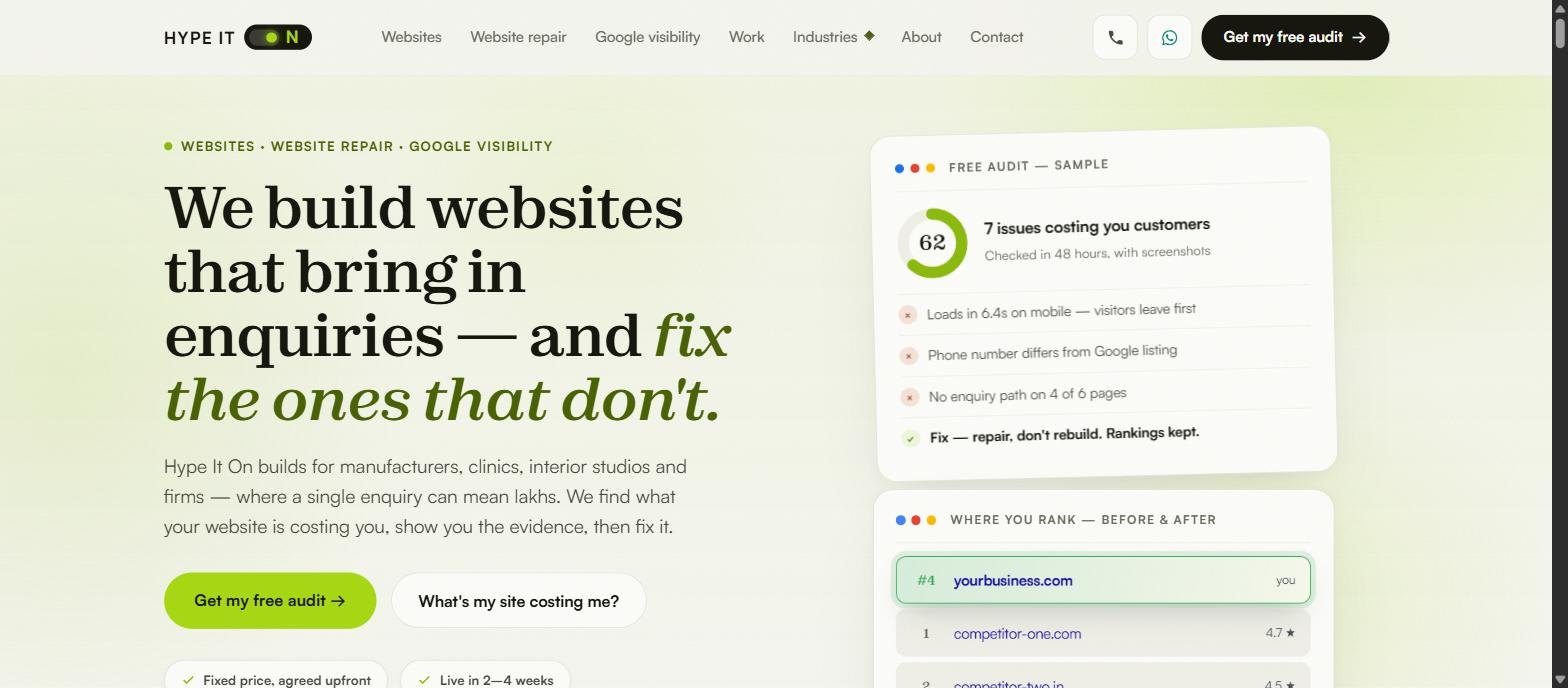
Homepage: the sample audit shows seven problems before the visitor types a word.
Homepage: the sample audit shows seven problems before the visitor types a word.hypeiton.com ↗
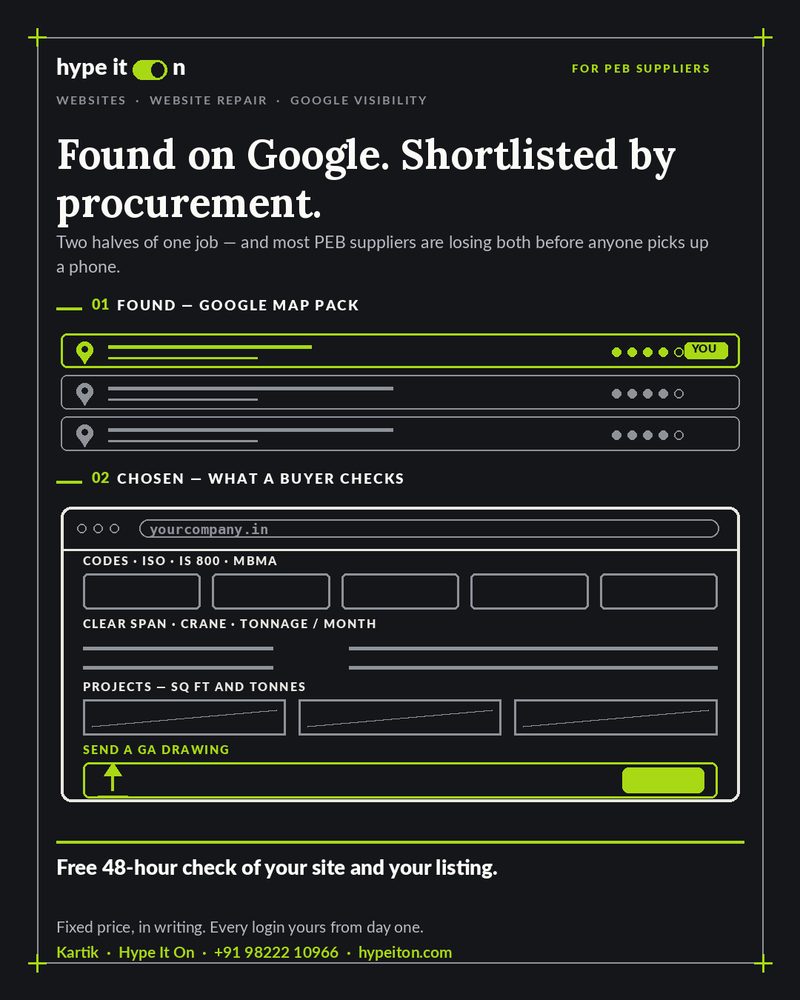
Ad: for steel-building suppliers
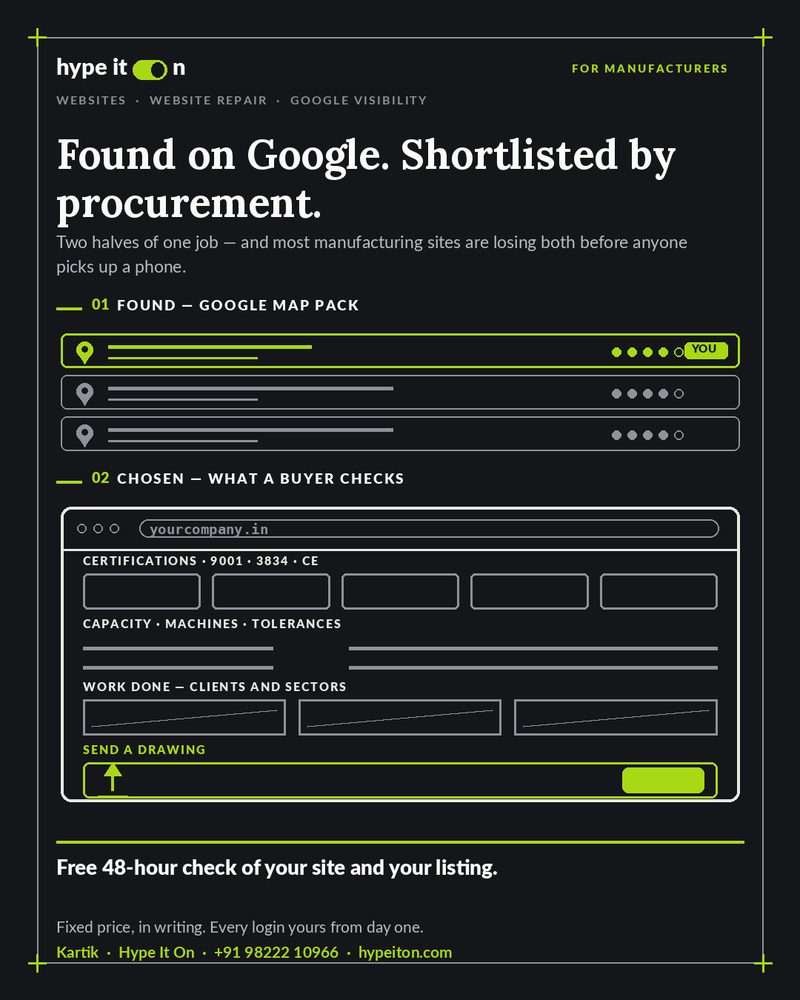
Ad: for manufacturers

The systems behind it

Client work delivered under this name

← All work
Style Story Salons · Local ads · Client follow-up · Print & social · Nagpur

Weekday chairs, filled.

A salon chain with busy weekends, empty weekdays, and first-time clients who rarely came back.

4.5×daily walk-ins, from 10 to 45
3-steprepeat-visit offer: 25%, 20%, 15%
Each salonwith its own local campaign

What was wrong

Chairs sat empty on weekdays and most new clients visited once. Every new client had to be paid for again.

What I did

Ads drawn around each salon, a follow-up system that brings first-time clients back with a stepped offer, and the salon’s menus, offers and social posts.

What changed

Daily walk-ins went from 10 to 45, and first visits started turning into second and third ones.

Print and social

Service menu: cover
Service menu: cover
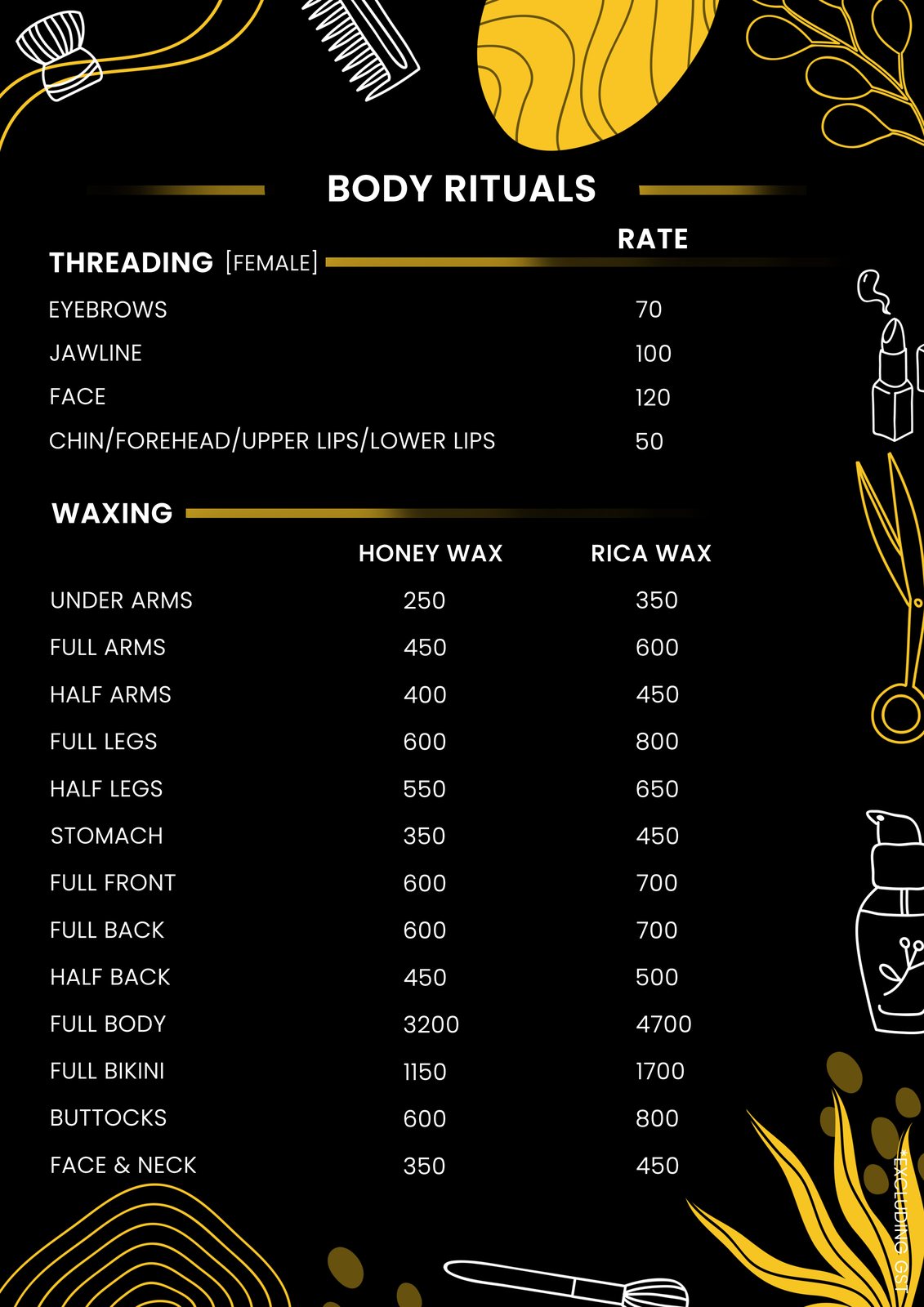
Service menu: body rituals
Flyer: first-visit offer
Stationery: envelope
Story: pre-wedding packages
Post: balayage
Post: balayage
Story: franchise partners
Story: express package
Post: men’s grooming
Story: festive menu
Story: festive menu

The systems behind it

← All work
Pixxel City · Website · Local SEO · Social · Nagpur

Nagpur’s biggest themed studio, made findable.

15+ themed sets, 500+ clients and 10,000+ sessions, but couples searching for a pre-wedding shoot in Nagpur found competitors instead.

5service pages, each ready to book
15+themed sets shown

What was wrong

No website and a weak Google profile, so the studio was invisible to the people already searching for it.

What I did

A booking-ready website with a page for each shoot type, a stronger Google Business Profile, and local content for Nagpur’s wedding and portrait market.

What changed

Every shoot type now has its own page to land on and book from, and Instagram posts lead back to a booking.

A page per service: pre-wedding shown here.
A page per service: pre-wedding shown here.pixxelcity.com ↗
Signature sets: each one a reason to book.
← All work
Magnum Ore Industry · B2B lead generation · Listings · Website · India

From word of mouth to steady enquiries.

A heavy-equipment manufacturer that sold only through word of mouth, with nothing online for buyers to find.

152buyer enquiries in one month
9product lines drawing enquiries

What was wrong

Buyers searching for equipment online found competitors. Sales depended entirely on who already knew the company.

What I did

Set up Google Business Profile, IndiaMART, JustDial, LinkedIn and Meta from scratch, wrote listings the way equipment buyers search, and sent every enquiry straight to sales.

What changed

152 buyer enquiries logged in a single month, across 9 product lines.

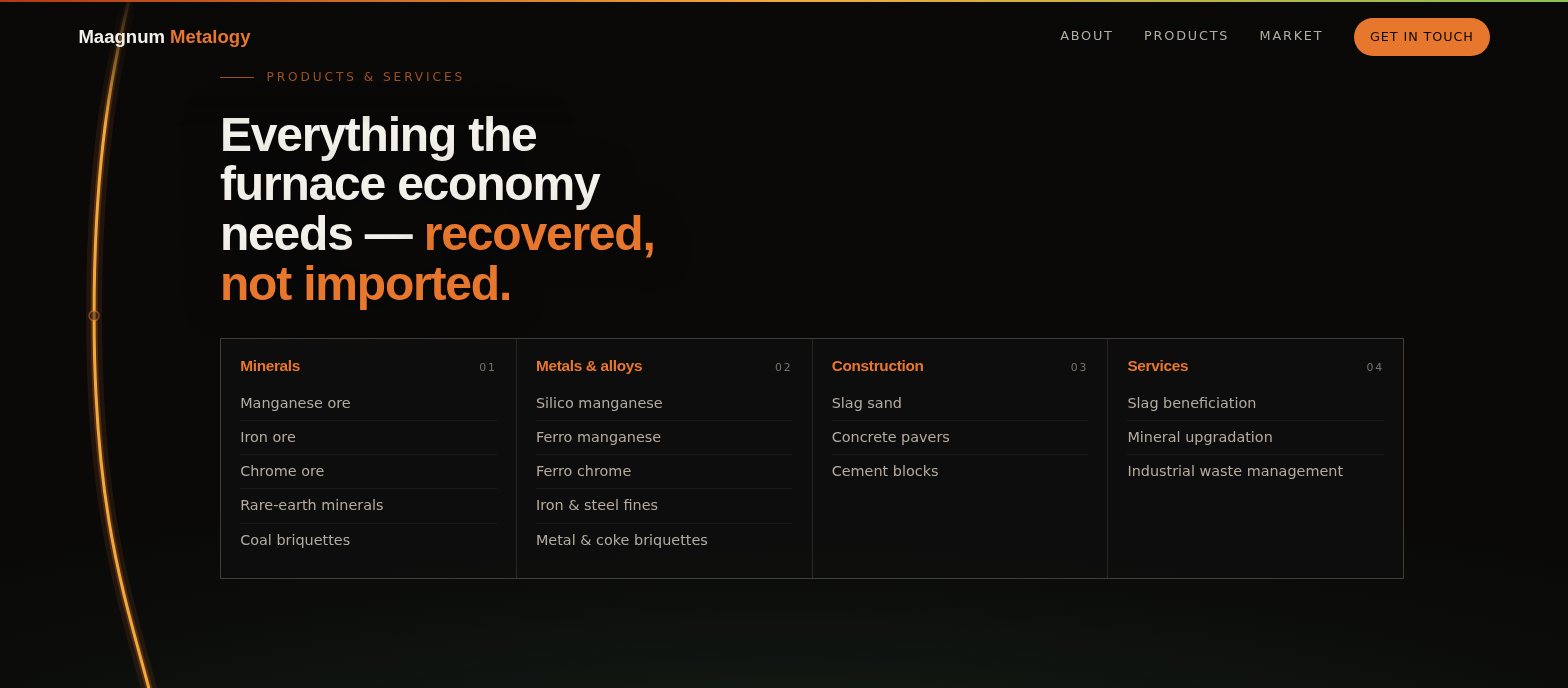
Website for the group’s recycling business.
Products arranged by what each furnace needs.
← All work
Nubius Network · Client via Hype It On · Australia

A two-sided security marketplace, marketed to both sides.

Nubius Network connects vetted security workers with businesses and security companies across Australia. It needs a steady flow of both: workers who sign up, and employers who post shifts.

2sides of the market, one plan
3channels run every month
8workflows in the growth-engine design
15buyer segments mapped, in 3 tiers

The growth engine, in one picture

Alongside the monthly marketing, I designed the system that recruits guards and finds businesses without the two getting out of step.

Two sides, one engineSystem design
  • Trigger
  • AI step
  • Check
  • Person
  • Saved
Guard side
TriggerA guard taps a WhatsApp adClick-to-WhatsApp
AI stepOnboarding chatReplies read into fields
PersonLicence checkedBy the Nubius team
SavedVerified guardReady for shift alerts
Business side
TriggerA public buying signalLicences, approvals, tenders, events
CheckScored against supplyAre verified guards nearby?
PersonOutreach, approved by a personDrafted from the signal
SavedDiscovery call bookedDeal opened in the CRM
Run 1Starting…

See the full design, branch by branch


The challenge

A marketplace is only as good as its thinner side. Ads, search and social each pulled in a different audience, with nobody steering them toward the same goal.

What I do

Run Google Ads, SEO and social media as one plan, with separate messages for security workers and for employers. Then design the automation that turns that attention into verified guards and booked calls.

Why it fits

Five years growing Taskmo, a two-sided gig marketplace in India, taught the playbook: recruit supply and demand together, and measure both.

← Design & content
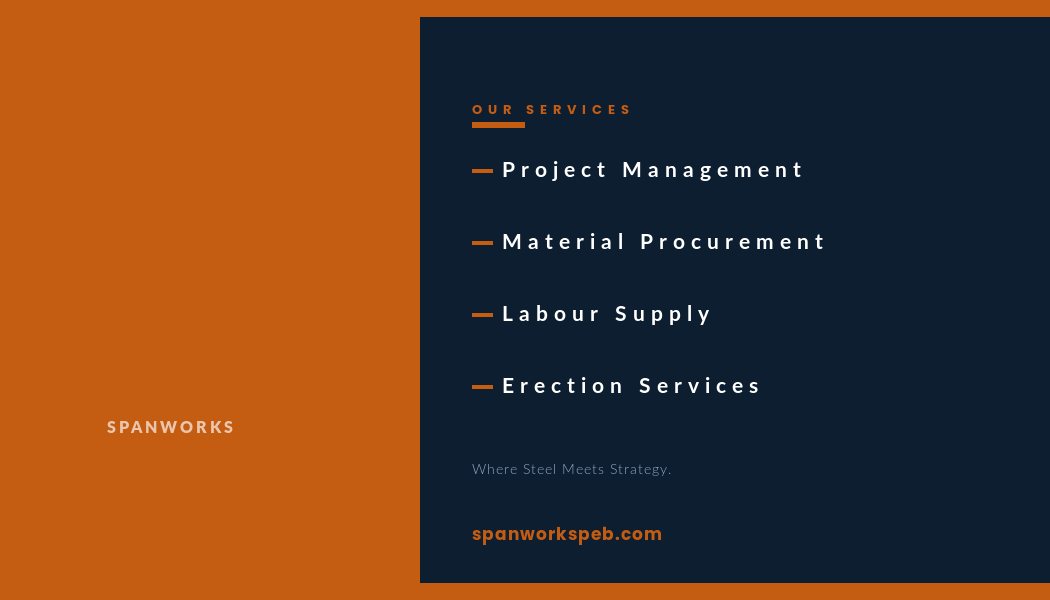
DesignSpanworks · Brand identity · Print · India

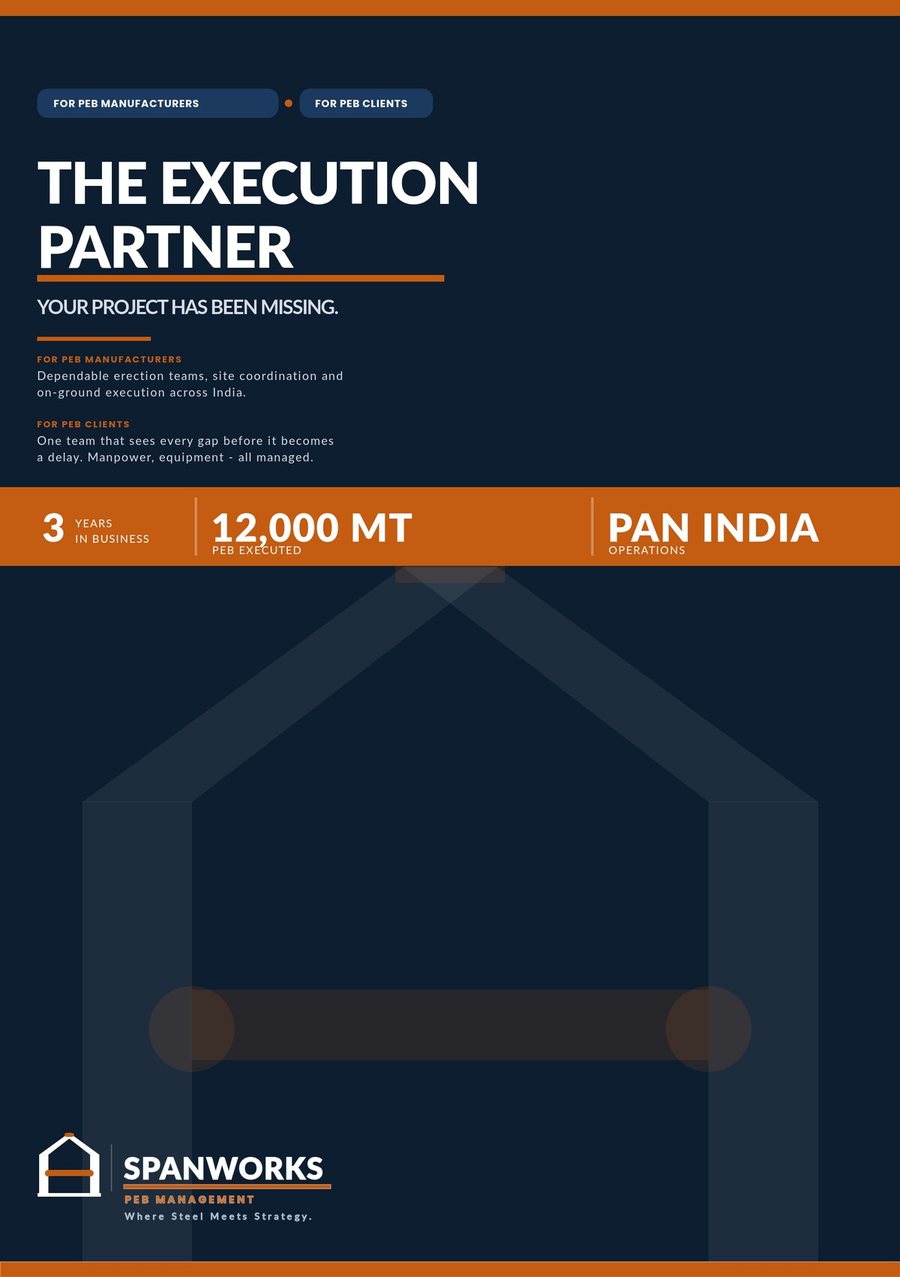
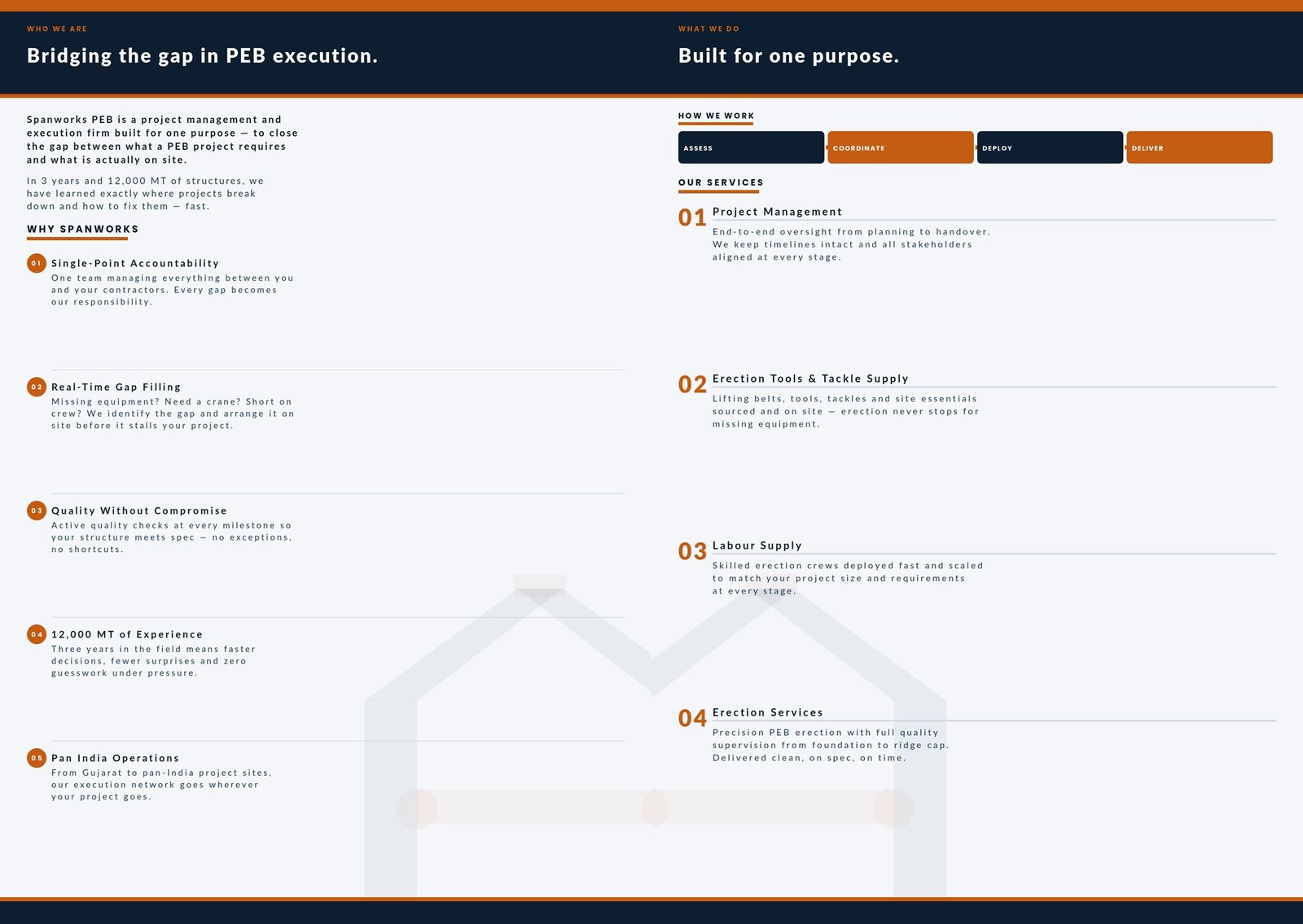
A steel-building firm that looks as solid as its steel.

A project partner for pre-engineered steel buildings, pitching to clients who had been let down by contractors before.

4-pagesales brochure
3logo colourways, plus an icon and brand rules

What was wrong

In this business, clients hire on trust. A new firm without a proper identity looked like one more subcontractor.

What I did

A logo drawn from the shape of the buildings they put up, brand rules, a business card, a letterhead and a four-page brochure.

What changed

A firm that walks into a pitch looking established, with one clear promise: one partner accountable for the whole project.

Brochure: inside spread.
Main logo.
Main logo.
Brochure: cover
Brochure: cover
Business card
Business card
← All automations
V4Veg   Live system

WhatsApp orders, entered without retyping

The problem

Restaurants sent orders late at night, in their own shorthand: “2kg tamatar, adrak 500g, dhaniya 4”. Every morning someone retyped each one by hand. It was slow, and one misread line meant the wrong vegetables on the truck.

How it works

  1. Message comes inThe restaurant’s WhatsApp order is forwarded or pasted in.
  2. Each line is readItem, quantity and unit are pulled out of every line.
  3. Matched to the price listUsing that restaurant’s own words for items, learned from past orders.
  4. Unsure lines flaggedA person checks only what the system isn’t sure about.
  5. Order savedTotals update for buying and billing. A resent order replaces the old one.

What it handles that a simple tool wouldn’t

  • Hindi, English and mixed spellings, tamatar, tomato, tomatoes
  • “½ kg”, “500 g”, “4 bunch”, “2 pc” and lines with no unit at all
  • Items sold by the piece but ordered by the kilo, converted automatically
  • Each restaurant’s nicknames for items, learned once and remembered
  • WhatsApp names, dates and timestamps stripped out
  • The same item written twice, merged into one line

What it looks like

What the kitchen sends.

Sample data
Order — Restaurant ARead and matched automatically
Sent asMatched itemQty
tamatar 8kgTomato Hybrid Large8 Kg
onion big 30 kgOnion Big Size30 Kg
adrak 1kgGinger1 Kg
dhaniya 8Coriander Leaves8 Pc
mushroom 4 pktMushroom4 Pc
limbu 1 kgLemon1 Kg
gobi 9Cauliflower9 Pc
baby corn 400gBaby Corn — check: imported or local?0.4 Kg

What lands in the order sheet. The one unsure line is flagged for a person.

The result

13/13lines matched exactly on a real restaurant order
Secondsinstead of retyping every order by hand
0new apps for restaurants, they keep using WhatsApp

Read the full V4Veg story

Doing something like this by hand?Show me how it’s done today. I’ll map what it costs and how it could run on its own, free.
Free workflow review
← All automations
V4Veg   Live system

The buying list, on the buyer’s phone the night before

The problem

The buyer leaves for the wholesale market before dawn. Adding up every kitchen’s order by hand meant late nights, missed items and over-buying.

How it works

  1. Orders closeAt night, once the last WhatsApp order is in.
  2. Totals worked outEach item added up across all kitchens.
  3. Split per kitchenSo the buyer knows who each kilo is for.
  4. Sorted by market sectionStandard, exotic and leafy, the order the buyer walks the market.
  5. Sent to the phoneOpen a link, share on WhatsApp or print. Nothing to install.

What it handles that a simple tool wouldn’t

  • Each item stays in its own unit, kilos, pieces, bunches
  • Kitchens over their credit limit are flagged before anything is bought for them
  • A column to write the day’s price, which then feeds billing
  • Tick boxes for what’s bought, strike-through for what wasn’t available

What it looks like

A real buy list. Kitchen names are shortened codes.

A real buy list. Kitchen names are shortened codes.

The result

33items on a typical night’s list, split by kitchen
Night beforeinstead of being worked out at the market

Read the full V4Veg story

Doing something like this by hand?Show me how it’s done today. I’ll map what it costs and how it could run on its own, free.
Free workflow review
← All automations
V4Veg   Live system

Daily price cards, built and sent every evening

The problem

Vegetable prices change daily. Sending each restaurant a clear, up-to-date price list every evening took time, and a plain text list looked like every other supplier.

How it works

  1. Today’s prices setFrom what was paid at the market.
  2. Selling rates setFor every item on the list.
  3. Cards builtA cover with the day’s big movers, then a page per category.
  4. Changes markedEvery price shows up or down against yesterday.
  5. Sent on WhatsAppThe cards go out in the evening; orders come back the same way.

What it handles that a simple tool wouldn’t

  • 100+ items across three category cards
  • Up and down markers against yesterday’s price
  • Sized for a phone screen, no zooming
  • Same look every day, so restaurants trust it

What it looks like

Cover: the day’s biggest price moves.

Cover: the day’s biggest price moves.

Category card: every change marked against yesterday.

Category card: every change marked against yesterday.

The result

100+items priced and designed every evening
3category cards, sized for WhatsApp

Read the full V4Veg story

Doing something like this by hand?Show me how it’s done today. I’ll map what it costs and how it could run on its own, free.
Free workflow review
← All automations
V4Veg   Live system

Billing and credit control

The problem

Bills were made by hand every morning. Nobody had a clear view of who owed what, and some kitchens kept ordering while paying late.

How it works

  1. Delivery confirmedIncluding anything that was short or swapped.
  2. Bill made per kitchenWith delivery charges where they apply.
  3. Payments matchedEach payment clears the oldest unpaid bills first.
  4. Balance and reminderA ready-to-send WhatsApp reminder per kitchen, listing the unpaid bills.
  5. Credit limit checkKitchens over their limit are flagged on the next buying list.

What it handles that a simple tool wouldn’t

  • Payments that cover several bills, or only part of one
  • A credit limit for each kitchen
  • Write-offs and adjustments kept on record, never silently deleted
  • Delivery charges added where they apply

What it looks like

Sample data
Outstanding — todayPayments matched oldest bill first
KitchenUnpaid billsOwedStatus
Kitchen A3₹12,480Remind
Kitchen B4₹21,360Over limit
Kitchen C1₹3,940Within terms
Kitchen D0₹0Clear

Sample balances.

The reminder writes itself from the ledger.

The result

Dailyview of every kitchen’s balance
Flaggedlate payers caught before the next delivery

Read the full V4Veg story

Doing something like this by hand?Show me how it’s done today. I’ll map what it costs and how it could run on its own, free.
Free workflow review
← All automations
V4Veg   Live system

Daily close and live profit dashboard

The problem

Cash, UPI, buyer payouts and running costs lived in different places. Profit on paper looked healthy while the bank balance said otherwise.

How it works

  1. Money logged onceSales, payments, purchases and expenses in one daily sheet.
  2. Books vs bankThe counted cash and bank balance are compared with the books.
  3. Gaps explainedAny gap above ₹2,000 needs a written note before the day closes.
  4. Day reportSales, cost of goods, profit, and profit after rent and salaries.
  5. Live dashboardMargins, break-even sales per day and price trends for every item.

What it handles that a simple tool wouldn’t

  • Owner withdrawals kept apart from business expenses
  • Rent and salaries spread fairly across each day
  • Closed days locked, so history doesn’t quietly change
  • Item-level price rises flagged before they eat the margin

What it looks like

Sample data
This monthUpdates every day
Sales so far₹1,84,300
Gross margin24.8%
After fixed costs₹7,900
Break-even / day₹5,150
This month / day₹7,680
Days traded24
Tomato+95%
Coriander+166%
Cucumber+38%
Onion+2%

Buy-price change, last 14 days vs the 14 before

The owner’s view: is this month making money, and which prices are moving.

The result

Dailyprofit, after fixed costs
Break-evensales per day, always up to date
Foundcosts that had never been recorded, and fixed how they’re logged

Read the full V4Veg story

Doing something like this by hand?Show me how it’s done today. I’ll map what it costs and how it could run on its own, free.
Free workflow review
← All automations
Eorb Solutions   Client system

Every paid lead answered and qualified in seconds

The problem

The ads worked too well. More WhatsApp enquiries arrived than the sales team could answer, and leads that waited an hour went cold, after the ad money was already spent.

How it works

  1. Lead clicks an adFrom Google, Meta or LinkedIn.
  2. Greeted in secondsOn WhatsApp, day or night.
  3. Questions, one at a timeWhat they need, by when, with what budget, and who decides.
  4. ScoredOn budget, timeline and decision power.
  5. Handed overQualified leads reach sales with the full chat. Unclear ones go to a person.

What it handles that a simple tool wouldn’t

  • Questions asked one at a time, the way a person would
  • Unclear answers sent to a person, never guessed
  • The full chat handed to sales, so nobody asks twice
  • Replies in seconds, day or night

What it looks like

Sample conversation.

The result

400+qualified leads a month
Secondsto answer every paid lead
2 weeksfrom brief to live

Read the full Eorb Solutions story

Doing something like this by hand?Show me how it’s done today. I’ll map what it costs and how it could run on its own, free.
Free workflow review
← All automations
Hype It On   Live system

A website audit that shows the loss in rupees

The problem

Business owners have heard “your website needs work” from every agency that called. Without a number, nobody believed it, so nobody booked a meeting.

How it works

  1. Enter a websiteAny business site.
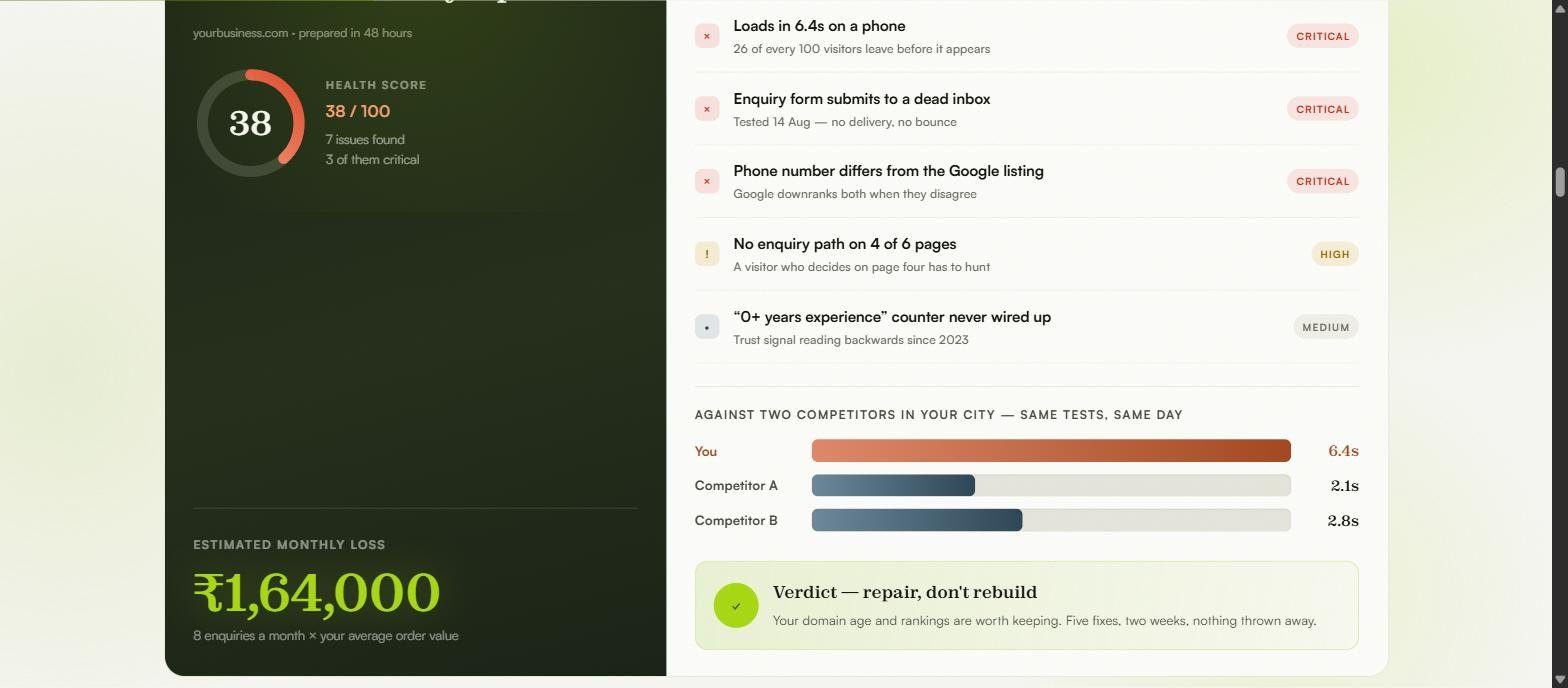
  2. Checked like a customer wouldLoad time on a phone, the enquiry form, the phone number, and the path to enquire on every page.
  3. Compared with two rivalsSame tests, same day, same city.
  4. Loss estimatedEnquiries lost a month × the average order value.
  5. Report with a verdictA health score, issues ranked by severity, and repair or rebuild.

What it handles that a simple tool wouldn’t

  • Actually submits the enquiry form, to catch forms that go to a dead inbox
  • Spots a phone number that doesn’t match the Google listing
  • Refuses to write a report when it can’t confirm the site is reachable, no invented problems
  • Recommends a repair when a rebuild isn’t needed

What it looks like

A real audit report: the estimated monthly loss and the verdict.

A real audit report: the estimated monthly loss and the verdict.

The result

₹ lossshown before the first call
48 hoursfrom request to report

Read the full Hype It On story

Doing something like this by hand?Show me how it’s done today. I’ll map what it costs and how it could run on its own, free.
Free workflow review
← All automations
Hype It On   Live system

Prospects found, checked and ranked overnight

The problem

Finding businesses that need help, and are worth calling, meant hours of manual searching and guessing, and cold calls to people who didn’t need anything.

How it works

  1. Businesses gatheredEvery night, by business type and suburb, in India and Australia.
  2. Each site auditedWith the same checks as the audit report.
  3. Ranked by needPoor fits removed; only the top 25 kept.
  4. Report built firstEach prospect gets a private report before anyone contacts them.
  5. Approved by a personOne click each: about 10 minutes a day.

What it handles that a simple tool wouldn’t

  • Sent from a separate domain, with an unsubscribe link, to protect the main inbox
  • One follow-up only if the report was opened, otherwise it stops
  • Replies sorted and sent straight to a person
  • Today’s replies shape tomorrow’s list

What it looks like

The full engine: find, audit, rank, approve, contact, then keep clients with monthly monitoring.

The full engine: find, audit, rank, approve, contact, then keep clients with monthly monitoring.

The result

25best-fit prospects a night, ranked by need
10 mina day of human review, the only manual step

Read the full Hype It On story

Doing something like this by hand?Show me how it’s done today. I’ll map what it costs and how it could run on its own, free.
Free workflow review
← All automations
Taskmo   Client system

Weekly growth reporting and test loop

The problem

A marketplace has to win two audiences at once, gig workers and the businesses that hire them, across many cities. Without a weekly view, budget kept flowing to ads that had stopped working.

How it works

  1. Campaigns splitBy audience and by city.
  2. Results gathered weeklyFrom every ad platform into one dashboard.
  3. Cost per lead comparedBy audience, city and ad.
  4. Budget movedLosing ads and audiences cut; winners get more.
  5. Leadership reviewReturn on spend reviewed every week, not every quarter.

What it handles that a simple tool wouldn’t

  • Two very different audiences measured separately
  • City-level results, not just national averages
  • New ads and audiences tested every week
  • One weekly view for leadership

What it looks like

Sample layout
Weekly review — cost per leadLayout shown with sample numbers
Leads this week1,284
Cost per lead−9% wk
Ads paused6
Workers · City ALow
Workers · City BLow
Employers · City AMid
Employers · City CCut

Every Monday: where cost per lead went up, and where the budget moves.

The result

81%lower cost per lead than the category benchmark
+180%LinkedIn followers in 12 months, organically
5 yearsrunning both sides of the marketplace

Read the full Taskmo story

Doing something like this by hand?Show me how it’s done today. I’ll map what it costs and how it could run on its own, free.
Free workflow review
← All automations
Style Story Salons   Client system

First visit to regular client

The problem

Chairs sat empty on weekdays, and most first-time clients never came back. Every new client was being paid for again and again.

How it works

  1. Found nearbyAds drawn around each salon, on social and search.
  2. First visit recordedThe client goes into the salon’s client list.
  3. Follow-up to rebookA reminder to come back, with the next offer.
  4. Stepped offer25% off the first visit, 20% the second, 15% the third.
  5. Regular clientBy the third visit, coming back is a habit.

What it handles that a simple tool wouldn’t

  • An offer that shrinks each visit, so the discount never becomes the price
  • The same offer in print, in the salon and on social
  • Campaigns drawn around each salon’s own neighbourhood
  • Festive menus and packages that give a reason to return

What it looks like

The real stepped offer: 25%, 20%, 15%.

The real stepped offer: 25%, 20%, 15%.

Sample reminder.

The result

3 visitsplanned from the very first one
Each salonwith its own local campaign

Read the full Style Story Salons story

Doing something like this by hand?Show me how it’s done today. I’ll map what it costs and how it could run on its own, free.
Free workflow review
← All automations
Clinics · salons · local services   Ready to deploy

Missed calls and forms, answered in a minute

A ready-to-deploy system, shown here on sample data. It’s set up around your business, your tools and your wording.

The problem

A busy clinic or salon misses calls all day. Most callers don’t leave a message; they call the next place on Google.

How it works

  1. Call missed or form filledDuring busy hours or after closing.
  2. WhatsApp reply in a minuteWith a friendly note and a booking link.
  3. What do they need?A couple of quick questions to route it right.
  4. RemindersIf they don’t book, a gentle follow-up, then it stops.
  5. BookedThe slot goes in the calendar and the owner is told.

What it handles that a simple tool wouldn’t

  • After-hours enquiries
  • The same person calling twice
  • Stops messaging the moment they book or say no
  • Owner sees every enquiry and where it came from

What it looks like , on sample data

Sample: a fictional clinic.

The result

< 1 minreply to every missed enquiry
Everyenquiry tracked to booked or lost
Doing something like this by hand?Show me how it’s done today. I’ll map what it costs and how it could run on its own, free.
Free workflow review
← All automations
Any local business   Ready to deploy

More Google reviews, and unhappy customers heard first

A ready-to-deploy system, shown here on sample data. It’s set up around your business, your tools and your wording.

The problem

Happy customers rarely leave reviews unless asked; unhappy ones always do. Most businesses ask nobody, so their rating is set by their worst days.

How it works

  1. Visit completedFrom the booking or billing record.
  2. Asked the same dayA short message asking how it went.
  3. Review link to everyoneGoogle doesn’t allow asking only happy customers, so everyone gets it.
  4. Low scores alert the ownerInstantly, with the customer’s details, to fix it fast.
  5. Monthly countNew reviews, average rating and issues raised.

What it handles that a simple tool wouldn’t

  • Follows Google’s review rules, no filtering out unhappy customers
  • No repeat asks to the same customer
  • Owner alerted on low scores within minutes
  • Works from the billing system the business already uses

What it looks like , on sample data

Sample data
Owner alertsToday
Low score — 2/5 · Table 6, 8:40 PM“Food was cold by the time it came.” — Rahul S. · 98xxxxxx21
5 new Google reviews this weekAverage 4.7 · 31 asked

Sample owner alerts.

The result

Same dayrequest after every visit
Minutesfor an owner to hear about a bad experience
Doing something like this by hand?Show me how it’s done today. I’ll map what it costs and how it could run on its own, free.
Free workflow review
← All automations
Any business running ads   Ready to deploy

Ad spend watchdog

A ready-to-deploy system, shown here on sample data. It’s set up around your business, your tools and your wording.

The problem

Ads break quietly: a form stops sending leads, cost per lead doubles, a campaign stops spending. Most owners find out in the monthly report, after the money is gone.

How it works

  1. Daily checkEvery Google, Meta and LinkedIn account.
  2. Compared with last weekSpend, leads and cost per lead.
  3. Something off?A jump, a drop, or zero leads from a live campaign.
  4. Alert on WhatsAppWhat changed, where, and what to check first.
  5. Weekly one-pagerThe week in five numbers.

What it handles that a simple tool wouldn’t

  • Weekends and holidays, so normal dips don’t cause false alarms
  • Leads that stop arriving even while ads keep spending
  • Several clients or brands in one view
  • Plain-language alerts, not raw numbers

What it looks like , on sample data

Sample data
Ad alertsTue 9:00 AM
Zero leads in 36 hours — Search · Brand₹4,820 spent since Sunday. Form submissions stopped Sunday 6 PM — check the website form.
Cost per lead up 48% — Meta · Lookalike₹612 vs ₹414 last week. Two ads are fatigued; new creative is due.

Sample alerts.

The result

1 dayto spot a broken campaign
5numbers in the weekly summary
Doing something like this by hand?Show me how it’s done today. I’ll map what it costs and how it could run on its own, free.
Free workflow review
← All automations
Suppliers · agencies · services   Ready to deploy

Unpaid invoices, followed up automatically

A ready-to-deploy system, shown here on sample data. It’s set up around your business, your tools and your wording.

The problem

Chasing payments is awkward, so it gets put off. Small businesses end up funding their customers for weeks.

How it works

  1. Invoice dueRead from the billing sheet or accounting tool.
  2. Friendly reminderOn the due date, with the bill and a payment link.
  3. Firmer reminderA week later, listing every unpaid bill.
  4. Owner call listAnyone two weeks late goes to the owner to call.
  5. Stops on paymentMatched automatically, so nobody is chased after paying.

What it handles that a simple tool wouldn’t

  • Part payments
  • Several unpaid bills in one message
  • Different terms per customer
  • No reminder sent after payment arrives

What it looks like , on sample data

Sample reminders.

The result

0awkward reminder messages to write by hand
Everyoverdue bill on one list
Doing something like this by hand?Show me how it’s done today. I’ll map what it costs and how it could run on its own, free.
Free workflow review
← All automations
Dental clinics   In development

CareLoop: treatment follow-up for clinics

CareLoop is a product I’m building. Clinics interested in an early version can get in touch.

The problem

Dentists recommend treatments every day that patients postpone, and then forget. That care, and that revenue, quietly disappears.

How it works

  1. Treatment suggestedRecorded at the visit, with the reason.
  2. Patient leavesWithout booking it.
  3. Follow-up in plain wordsWhy it matters, and what waiting could mean.
  4. Spaced remindersAt set intervals, never pushy.
  5. Clinic viewEvery postponed treatment, its value and status.

What it handles that a simple tool wouldn’t

  • Stops when the patient books or says no
  • Messages written for patients, not clinicians
  • A clear list of pending treatments for the front desk
  • Respects quiet hours

What it looks like , on sample data

Sample: a fictional clinic.

The result

Pendingtreatments made visible to the clinic
Doing something like this by hand?Show me how it’s done today. I’ll map what it costs and how it could run on its own, free.
Free workflow review
← All automations
Nubius Network, via Hype It On   System design

A growth engine for both sides of a marketplace

The problem

A shift marketplace fails on its thinner side. A guard who starts signing up and never finishes is wasted ad spend. A business pitched in a suburb with no verified guards nearby is a promise that breaks on the first shift.

This is a design, shown with the client’s structure but not its targets: eight workflows on one self-hosted automation server and one database, planned around a four-week pilot.

8workflows, from first ad click to weekly report
2WhatsApp numbers: one for guards, one for businesses
15buyer segments in 3 tiers
4weeks to the pilot review

Guard side: onboarding on WhatsApp

A fixed sequence of steps, not a free-roaming agent. The AI only turns free-text replies into fields; the workflow decides what happens next. Watch three different guards go through.

Guard onboarding on WhatsAppSystem design
  • Trigger
  • Automated
  • AI step
  • Check
  • Person
  • Saved
  • Stop
TriggerA guard taps the adAnd sends a first message
CheckOpt-out, or asked for a person?Checked on every message
PersonOps alerted, bot pausedWith the full transcript
AI stepReply read into fieldsState, licence class, suburb, availabilityWith a confidence score
CheckConfident and complete?The workflow decides, not the AI
AutomatedOne clarifying questionTwo tries at most
CheckInside the pilot city?
StopWaitlistedTold when their city opens
AutomatedSign-up link sentWith a personal code
AutomatedNudges at 24 and 72 hoursApproved templates only
PersonLicence checked on the state registerBy the Nubius team
SavedProfile liveEligible for shift alertsVerified guard
Run 1Starting…

Business side: from a signal to a booked call

The score decides the channel, and a supply check comes first: no business is pitched in an area where the platform can’t fill its shifts yet.

From a public signal to a booked callSystem design
  • Trigger
  • Automated
  • AI step
  • Check
  • Person
  • Saved
  • Stop
TriggerWeekly sweep, daily signal checksLicences, approvals, tenders, events
AutomatedCleaned and de-duplicatedMatched on ABN, domain or address
CheckEmail published on their own site?With an active ABN
PersonPhone and LinkedIn onlyRouted to a person
AI stepSegment tagged, summary writtenOne line per company
AutomatedAccount scoredSignal, recency, tier, distance to guardsHot, warm or nurture
CheckEnough verified guards nearby?The supply check
StopHeld until supply existsNo pitch we can’t fill
AI stepOpening line draftedFrom their website and the signal
PersonA person approves or editsEvery draft, during the pilot
AutomatedSent from a separate domainSender ID and unsubscribe in every email
AI stepReply classifiedInterested, not now, unsubscribe, unclear
SavedBooking link, deal, team alertIn the CRMDiscovery call
Run 1Starting…

Rules built into the flows

  • WhatsApp’s 24-hour windowFree-text replies only within 24 hours of the guard’s last message. Every later nudge is a pre-approved template.
  • Consent you can showEmail only to addresses a business publishes on its own site, stored with the source page and the date collected.
  • One unsubscribe, every channelHonoured within 5 business days and suppressed across email, LinkedIn and WhatsApp.
  • Licence numbers stay privateHeld in a restricted column, kept out of logs, in a database hosted in Sydney.
  • People keep the judgment callsLicence verification, draft approval in the pilot and discovery calls stay with the Nubius team.
  • The client owns everythingAd accounts, WhatsApp numbers, server, database and code are in Nubius’s name from day one. My admin access ends at handover.

What keeps it running after handover

  • Any failed workflow raises an alert with a link to the exact run
  • Every workflow is exported to the client’s private code repository each night
  • A Monday report: reply rate by message angle, guard drop-off by step, cost per verified guard
  • API keys rotated and WhatsApp quality ratings reviewed every quarter

What the pilot is measured on

  • Cost per verified guard from WhatsApp ads
  • Onboarding completion rate, and the worst drop-off step
  • Positive reply rate by segment and message angle
  • Discovery calls booked and first shifts filled
Designed on
  • n8n, self-hosted in queue mode
  • Postgres on Supabase
  • WhatsApp Cloud API
  • Instantly
  • HubSpot
  • Claude and OpenAI APIs

Read the full Nubius Network story

Running a two-sided business?Show me where supply and demand fall out of step. I’ll map how it could run on its own, free.

Free workflow review
Let’s talk

Tell me what’s slowing the business down. I’ll show you how to fix it.
Working from Bengaluru (IST): mornings overlap Australia, afternoons the UK and Europe, evenings the US East Coast.